Reverse parking is an essential driving skill that every driver should master. It involves carefully maneuvering a vehicle into a parking space while reversing. This technique is not only convenient but also a sign of a skilled driver.
Mastering parking techniques like reverse parking can significantly enhance one’s driving abilities. It requires a combination of practice, patience, and understanding of the vehicle’s dimensions and surroundings.
Despite its benefits, reverse parking can be challenging, especially in tight spaces or busy parking lots. However, with the right guidance and practice, anyone can become proficient in this valuable driving skill.
Key Takeaways
- Reverse parking is a valuable driving skill that enhances one’s ability to maneuver a vehicle.
- It requires practice, patience, and a good understanding of the vehicle’s dimensions.
- Mastering reverse parking can boost a driver’s confidence.
- It’s a convenient parking technique, especially in tight spaces.
- Proper guidance and practice are key to becoming proficient in reverse parking.
The Benefits of Reverse Parking
Mastering the art of reverse parking not only improves vehicle maneuvering skills but also provides several safety benefits. This technique involves backing into a parking spot, which can significantly enhance overall driving skills.
Safety Advantages
One of the primary benefits of reverse parking is the improvement in parking safety. By backing into a spot, drivers can avoid potential collisions that may occur when exiting a parking space. This is particularly important in busy parking lots where pedestrians and other vehicles are constantly moving.

Improved Visibility When Exiting
When you reverse park, you have a clearer view of the surrounding area when you leave the parking space. This reduces the risk of accidents caused by poor visibility.
Easier Departure in Emergency Situations
In emergency situations, having your vehicle facing the right direction can be crucial. Reverse parking ensures that you can leave a parking space quickly and safely, without having to back out into potentially busy traffic.
Essential Preparation Before Reverse Parking
Before you start reverse parking, it’s crucial to prepare yourself and your vehicle for the maneuver. Proper preparation can significantly reduce the risk of accidents and make the process smoother.
Adjusting Your Mirrors Properly
Adjusting your mirrors is the first step in preparing for reverse parking. Ensure that your rearview and side mirrors are adjusted to provide a clear view of the surrounding area. Proper mirror adjustment can help you detect obstacles and judge distances more accurately.
Understanding Your Vehicle’s Dimensions
Knowing your vehicle’s dimensions is vital for reverse parking. Familiarize yourself with the length, width, and height of your vehicle, as well as any protruding features like tow hooks or wide mirrors. This knowledge will help you navigate tight spaces with confidence.
Checking for Obstacles and Clearance
Before reversing into a parking spot, check for any obstacles or clearance issues. Look for pedestrians, other vehicles, and any objects that could interfere with your parking maneuver. Use your vehicle’s sensors and cameras if available.
| Preparation Step | Description | Benefit |
|---|---|---|
| Adjust Mirrors | Adjust rearview and side mirrors for clear view | Improved visibility |
| Know Vehicle Dimensions | Familiarize yourself with vehicle’s length, width, and height | Better spatial awareness |
| Check for Obstacles | Look for pedestrians, other vehicles, and objects | Reduced risk of accidents |
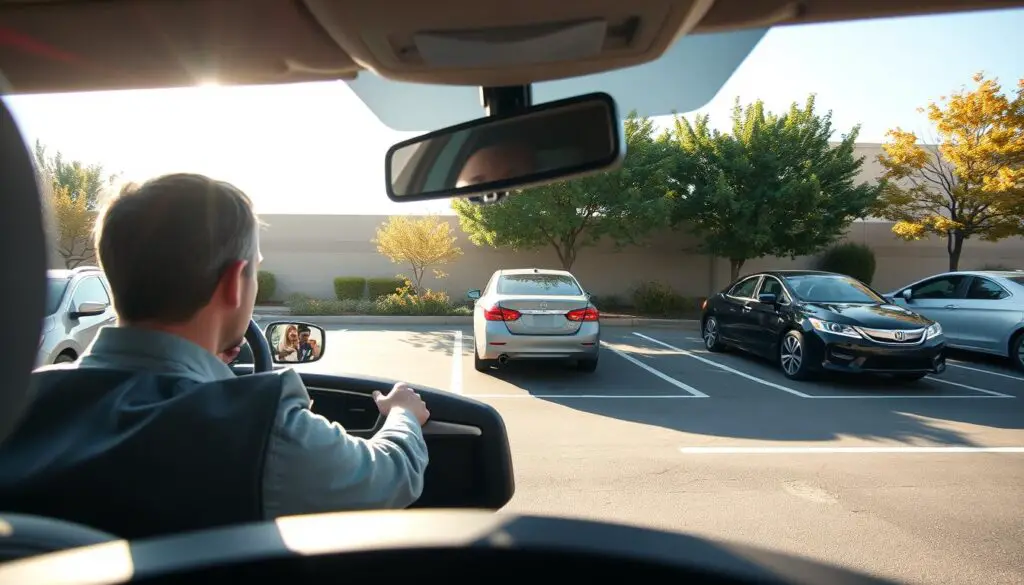
How to Back into a Parking Spot: Mastering the Reverse Maneuver
To back into a parking spot with ease, it’s crucial to follow a systematic approach. This involves a series of steps that, when executed correctly, make reverse parking a straightforward task.
Positioning Your Vehicle Before Backing Up
Before reversing into a parking spot, align your vehicle parallel to the parking space and about one foot away from the adjacent vehicle. Check your mirrors and blind spots for any obstacles or pedestrians.
The 45-Degree Approach Technique
The 45-degree approach is a widely recommended technique for reverse parking. It involves positioning your vehicle at a 45-degree angle to the parking space before reversing. This technique allows for better alignment and easier maneuvering into the spot.
Using Reference Points for Perfect Alignment
Using reference points on your vehicle can help you align perfectly with the parking space. Common reference points include the vehicle’s mirrors and the edges of the bumper. Practice using these reference points to gauge the distance between your vehicle and the surrounding objects.
When to Turn the Steering Wheel
Turning the steering wheel at the right moment is critical for successful reverse parking. As a general rule, start turning the wheel when your vehicle’s rear bumper is aligned with the edge of the parking space. The direction of the turn depends on the orientation of your vehicle relative to the parking spot.
| Situation | Action |
|---|---|
| Reversing into a spot on your left | Turn the steering wheel to the left |
| Reversing into a spot on your right | Turn the steering wheel to the right |
As driving expert,
“The key to mastering reverse parking is practice and patience. It’s not just about following the steps, but also understanding how your vehicle responds to different maneuvers.”
By following these guidelines and practicing regularly, you can become proficient in reverse parking.
Step-by-Step Guide to Reverse Parking
The key to successful reverse parking lies in understanding the process and breaking it down into manageable steps. By following a systematic approach, you can master this essential driving skill.
Identifying a Suitable Parking Space
Before you begin, it’s crucial to identify a suitable parking space. Look for a spot that is large enough for your vehicle and is free from obstacles. Check for any parking restrictions or signs indicating reserved spaces.
Signaling Your Intentions to Other Drivers
Once you’ve identified a suitable parking space, signal your intentions to other drivers. This helps prevent misunderstandings and reduces the risk of accidents. Use your turn signal to indicate that you’re about to reverse into the parking space.
The Reverse Parking Sequence
The reverse parking sequence involves several key steps. These include initial positioning, turning points, and final adjustments.
Initial Positioning
Align your vehicle with the parking space and check your mirrors and blind spots. Position your vehicle at a 45-degree angle to the parking space, with your rear bumper aligned with the space.
As you reverse, check your reference points and turn the steering wheel when necessary. The turning points will vary depending on the size of your vehicle and the parking space.
Final Adjustments
Once you’re mostly in the parking space, make any final adjustments. Straighten out your vehicle and check that you’re within the lines.
By following this step-by-step guide, you can become proficient in reverse parking and park with confidence.
Technology and Tools to Assist with Reverse Parking
Modern vehicles are increasingly equipped with advanced technologies designed to make reverse parking safer and more efficient. These innovations have significantly reduced the complexity and stress associated with backing into a parking spot.
Backup Cameras and How to Use Them Effectively
Backup cameras provide a clear view of the area behind the vehicle, helping drivers detect obstacles that may not be visible through the rearview mirror. To use them effectively, drivers should adjust the camera settings for optimal clarity and be aware of the camera’s limitations, such as blind spots.
Parking Sensors and Distance Indicators
Parking sensors and distance indicators alert drivers to potential collisions by detecting objects near the vehicle. These systems use audible beeps or visual displays to signal the proximity to obstacles, allowing for more precise maneuvering.
Advanced Parking Assistance Systems
Advanced Parking Assistance Systems (APAS) take the guesswork out of parking by automating the steering process. These systems use a combination of sensors and cameras to guide the vehicle into a parking space, making it easier to park in tight spots.
When to Rely on Technology vs. Traditional Skills
While technology has greatly enhanced the parking experience, it’s essential for drivers to understand when to rely on these tools versus traditional parking skills. Drivers should be proficient in both, as technology can sometimes fail or be limited by environmental factors.
| Technology | Benefits | Limitations |
|---|---|---|
| Backup Cameras | Enhanced rear visibility | Blind spots, weather interference |
| Parking Sensors | Obstacle detection, audible warnings | Sensor malfunctions, false alerts |
| APAS | Automated steering, ease of use | Dependence on technology, limited adaptability |
Common Mistakes and How to Avoid Them
To become proficient in reverse parking, it’s crucial to identify and learn from the most common errors drivers make. Understanding these mistakes can significantly improve your parking skills and reduce the risk of accidents.
Incorrect Starting Position
One of the most critical aspects of successful reverse parking is starting from the correct position. Aligning your vehicle properly with the parking space before reversing is essential. An incorrect starting position can lead to difficulties in judging the distance and aligning your vehicle correctly within the space.
Turning the Wheel Too Early or Too Late
Timing is everything when it comes to turning the steering wheel during reverse parking. Turning too early or too late can result in your vehicle not fitting into the space or hitting the surrounding cars. Practice makes perfect, and getting a feel for when to turn the wheel is crucial.
Misjudging Distance and Space
Misjudging the distance between your vehicle and the surrounding objects is another common mistake. Using your vehicle’s mirrors and backup camera (if equipped) can help gauge these distances more accurately. It’s also helpful to use reference points on your vehicle to judge the distance to the objects around you.
Rushing the Process
Rushing through the reverse parking maneuver can lead to a variety of mistakes, from misjudging distances to failing to check for obstacles. Take your time and go slowly, checking your mirrors and looking over your shoulder to ensure you’re aware of your surroundings.
By being aware of these common mistakes and taking steps to avoid them, you can improve your reverse parking skills and become a more confident driver.
Mastering Reverse Parking in Different Vehicles and Situations
Mastering reverse parking requires adapting techniques to various vehicles and situations. The ability to reverse park effectively is crucial for drivers, as it enhances safety and reduces the risk of accidents.
Techniques for Sedans vs. SUVs and Trucks
Different vehicles have unique characteristics that affect reverse parking. For instance, SUVs and trucks have larger blind spots and longer rear ends, requiring adjustments in technique. Drivers should be aware of their vehicle’s dimensions and use reference points accordingly.
Backing into Angled Parking Spaces
Angled parking spaces require a different approach than traditional perpendicular parking. Drivers need to align their vehicle with the angle of the parking space and use their mirrors and cameras effectively to gauge distance.
Reverse Parking in Tight Garages
Tight garages demand precision and patience. Using parking sensors and backup cameras can significantly aid in navigating these confined spaces.
Dealing with Sloped Surfaces
Sloped surfaces can complicate reverse parking by affecting the vehicle’s trajectory. Drivers should be cautious and adjust their speed accordingly to maintain control.
Reverse Parking in Adverse Weather Conditions
Adverse weather, such as rain or snow, can reduce visibility and traction. Drivers should slow down and use their vehicle’s safety features to assist with reverse parking in these conditions.
Conclusion
Mastering the technique of reverse parking is a valuable skill that enhances safety, convenience, and confidence on the road. By understanding the benefits, preparing properly, and practicing the steps outlined in this article, drivers can significantly improve their parking skills.
Effective reverse parking involves a combination of proper mirror adjustment, understanding vehicle dimensions, and using reference points for alignment. By following the step-by-step guide and avoiding common mistakes, drivers can become proficient in backing into a parking spot.
As technology continues to evolve, tools like backup cameras and parking sensors can assist with reverse parking. However, it’s essential to balance reliance on technology with traditional skills to ensure proficiency in various situations and vehicles.
By practicing and refining reverse parking techniques, drivers can enjoy improved safety, reduced stress, and increased confidence when parking in a variety of situations.
FAQ
What are the benefits of reverse parking?
Reverse parking offers several benefits, including improved safety, increased visibility when exiting a parking spot, and easier departure in emergency situations.
How do I adjust my mirrors for reverse parking?
To adjust your mirrors for reverse parking, position them to provide a clear view of the area behind and around your vehicle, ensuring you can see the parking space and any obstacles.
What is the 45-degree approach technique in reverse parking?
The 45-degree approach technique involves aligning your vehicle at a 45-degree angle to the parking space before backing into it, making it easier to maneuver into the spot.
How do backup cameras assist with reverse parking?
Backup cameras provide a clear view of the area behind your vehicle, helping you to detect obstacles, align with the parking space, and avoid accidents.
What are some common mistakes to avoid when reverse parking?
Common mistakes to avoid when reverse parking include incorrect starting positions, turning the wheel too early or too late, misjudging distance and space, and rushing the process.
How do I reverse park in tight garages or sloped surfaces?
To reverse park in tight garages or on sloped surfaces, use reference points on your vehicle to gauge distance, and adjust your speed and steering accordingly to maintain control and avoid accidents.
Can advanced parking assistance systems replace traditional reverse parking skills?
While advanced parking assistance systems can aid with reverse parking, they should not entirely replace traditional skills, as understanding the fundamentals of reverse parking is still essential for safe and effective parking.
How do I master reverse parking in different vehicles, such as SUVs or trucks?
To master reverse parking in different vehicles, understand the unique dimensions and handling characteristics of your vehicle, and adjust your techniques accordingly, taking into account factors like vehicle size and turning radius.