This short guide walks through a practical, safety-first approach when your warning light appears on the dash. Start by confirming the lamp, then follow safe on-road steps to encourage regeneration and prevent escalation.
The particulate system traps soot from exhaust and uses periodic regeneration to burn it off. Frequent short trips or low-speed city driving can stop that process and trigger the light.
Try a steady drive near 40 mph for about ten minutes to raise exhaust temperature and let the system regenerate. If the lamp clears, monitor performance and emissions. If it stays on, scan for codes such as P2002, P2463, or P0420 to narrow down issues before calling a technician.
Act early to avoid higher backpressure, reduced power, worse fuel use, or the vehicle entering limp mode to protect the aftertreatment system.
Key Takeaways
- Confirm the dashboard lamp, then attempt a controlled regeneration drive.
- The particulate filter traps soot; regeneration prevents clogging and emissions issues.
- Short, slow trips often cause the light to appear — don’t ignore it.
- Scan for common codes if the lamp stays on; professional help may be needed.
- Early action limits damage, fuel waste, and risk of reduced-power mode.
Understand what the DPF warning light means and why it matters
Seeing the dash light means the exhaust aftertreatment is collecting soot faster than it can burn it off. This alert tells you the particulate filter is nearing capacity and needs heat and time to complete regeneration to protect emissions and engine performance.
Some cars show a dedicated symbol, while others use a generic check-engine or exhaust lamp. A dedicated dash light signals higher urgency and is focused on soot and regeneration status.
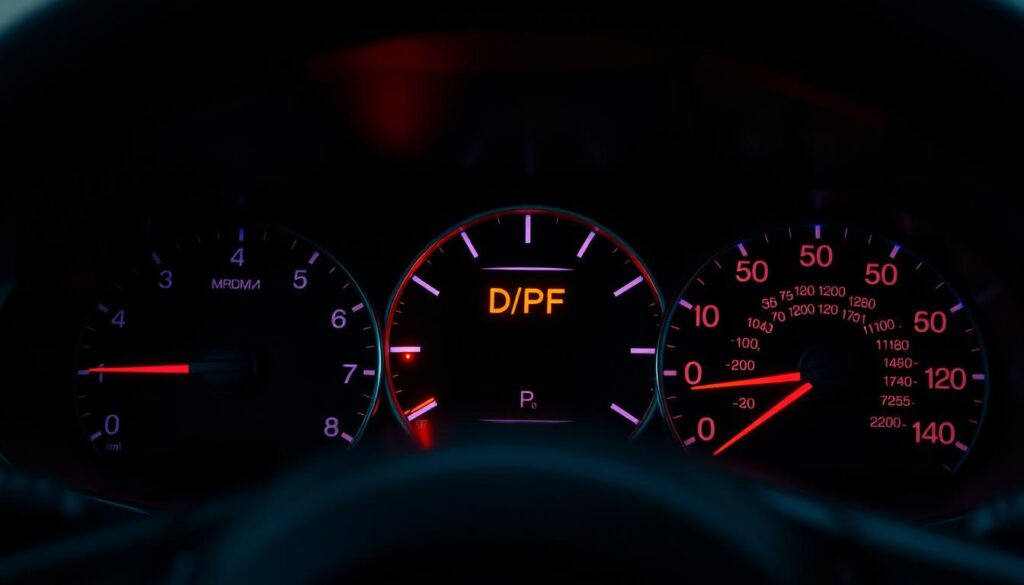
Short, low-speed trips, long idles, and stop‑and‑go driving keep exhaust temperature too low for normal regeneration. The engine control logic watches exhaust temperature and pressure differential and will illuminate the light if thresholds are met.
Occasionally a faulty pressure sensor or blocked line can mimic a loaded unit. If the light stays on after a recommended drive, scan for codes and check sensor readings before assuming the unit is full.
Acting promptly matters. Sustained backpressure raises fuel use, stresses the turbo and engine, and can force the car into reduced-power mode to prevent further harm. Normal regeneration needs steady speed, enough load, and sufficient temperature to clear soot.
Immediate actions: safe checks and on‑road regeneration to try first
Before you attempt any sustained drive, confirm the car shows no severe symptoms and that fuel, fluids, tires, and brakes are in good order. Do not continue if you notice heavy smoke, violent misfires, or overheating.
Quick safety checklist:
- Verify sufficient fuel level for at least 20 minutes of driving.
- Look for visible leaks and check engine coolant and oil gauges.
- Confirm tires and brakes are safe for highway speeds.
When safe, aim for a steady drive near 40 mph for about ten minutes. This raises exhaust temperature and often allows the regeneration process to complete. Choose a route with consistent speeds and, where legal, use cruise control to hold pace.
Warm the engine first so temperature climbs quickly. Reduce heavy electrical loads and avoid towing to keep exhaust heat steady. Monitor the dash: if the light clears, keep driving at steady speeds a few more minutes to finish the cycle.
“If the light persists or the car enters reduced-power mode, stop and move to diagnostics rather than forcing more drives.”
How do I troubleshoot a DPF (diesel particulate filter) warning message?
Start by identifying the exact dash icon. Check whether the vehicle shows a soot-specific light, a check-engine lamp, or an exhaust system alert. That distinction helps prioritize whether the issue is sensor-related, an emissions chemistry problem, or a true clog.
Attempt a controlled on‑road regeneration
If safe, take a steady drive near 40+ mph for about ten minutes. This often raises exhaust temperature enough to allow normal regeneration to complete.
Scan for trouble codes
Use an OBD-II scanner and watch for P2002, P2463, P246C, P0420, and P0473. These codes point to efficiency, soot buildup, temperature issues, catalyst chemistry, or high exhaust pressure.
Verify sensor data and driving patterns
- Compare differential pressure and exhaust temperature readings to expected ranges; implausible sensor values may show wiring or sensor faults.
- Review recent short trips, slow city runs, or heavy idling that raise soot and stall regeneration.
- Inspect for visible exhaust leaks, broken clamps, or canister damage that can mimic a saturated unit.
“If the indicator stays on after a proper drive and scans show no simple fix, stop driving and seek professional diagnostics to avoid engine derate.”
Tip: Note recent fuel quality and refills; poor fuel can raise soot production and hinder dpf regeneration.
Common causes and warning signs of DPF issues you can diagnose
Noticing changes in drivability or exhaust behavior is often the first clue of a clogged system. Read the signs below so you can act before damage spreads.
Decreased engine performance and increased backpressure
Sluggish acceleration and trouble keeping speed on grades point to rising exhaust backpressure from a blocked particulate filter. The engine works harder and feels less responsive.
Dashboard lights and failed regenerations
Repeated warning lights or a light that returns shortly after a drive usually mean regeneration did not complete. That calls for diagnostic scans and sensor checks.
Black smoke and severe damage
Any black smoke from the tailpipe suggests a cracked substrate, bypass, or full clog. This is urgent and needs inspection to avoid further damage.
Rising fuel use and limp mode
Higher fuel consumption often follows soot buildup. The ECM may switch to limp mode to protect the aftertreatment, limiting power and speed.
“Capture drive patterns, timing, and any codes to share with your technician for faster diagnosis.”
| Symptom | What it means | Urgency | Suggested next step |
|---|---|---|---|
| Sluggish acceleration | High backpressure from soot | Medium | Attempt steady higher-speed drive; scan if unresolved |
| Warning light returns | Failed or incomplete regeneration | High | Scan for codes; check sensors and wiring |
| Black smoke | Cracked or fully blocked unit | Immediate | Stop driving; have technician inspect |
| Increased fuel use / limp mode | Engine working against restriction | High | Diagnostic and possible cleaning or replacement |
When to call a pro: forced regeneration, cleaning, or replacement
If the light stays after a proper highway run, schedule professional service. Repeated alerts, limp mode, or poor drivability mean shop tools and experience are needed to prevent further engine or emissions damage.
What a shop will do
Diagnostics first. Technicians scan for codes such as P2002, P2463, P246C, P0420, and P0473 to pinpoint the cause.
They inspect for leaks and physical damage, then validate pressure and temperature sensor signals before choosing service.
Options include manual or forced regeneration, off‑vehicle cleaning, or complete replacement depending on soot and ash condition.
Preventing repeat problems
Follow service intervals and use correct low‑ash oil to protect emissions systems and engine efficiency.
Schedule regular highway drives to allow normal regeneration and consider vetted cleaner fuel additives used as directed to reduce soot formation.
“Early intervention cuts costs and limits secondary damage to turbochargers, DOCs, and the engine.”
- Document time, mileage, and driving conditions from the last successful regeneration to help the technician.
- Replace the unit when the substrate is cracked, melted, or ash exceeds service limits; cleaning helps only when the structure is sound.
Conclusion
A prompt, orderly response to the dash alert limits engine stress and keeps emissions in check.
First, confirm the exact light, attempt a steady 40+ mph drive for about ten minutes, and scan for codes such as P2002, P2463, P246C, P0420, and P0473. Check sensor readings if codes seem inconsistent.
Acting quickly helps prevent limp mode and reduces repair costs. Codes like P2002 and P2463 point to high soot load or efficiency loss, while P246C often shows temperatures are too low for the process to begin.
Repeated alerts often mean driving patterns, buildup beyond capacity, or a faulty pressure sensor that needs correction. If the light stays on after a proper attempt, minimize driving and book professional diagnostics for forced regeneration, cleaning, or replacement.
Prevent repeat issues with occasional highway runs, correct oil, vetted cleaner additives, and attention to early signs like subtle performance loss or smoke.
FAQ
What does the DPF light mean and why should it be taken seriously?
The amber indicator signals soot accumulation in the exhaust aftertreatment. Left unaddressed, buildup raises backpressure, reduces fuel economy, triggers limp mode, and can damage the turbocharger and engine. Treat the notice as a prompt to inspect driving habits and run a regeneration before the system locks into a fault state.
What quick safety checks should I do before attempting an on‑road regeneration?
Verify coolant and oil levels, confirm the fuel tank has enough diesel, and ensure the engine is at normal operating temperature. Choose a safe stretch of road where you can maintain sustained speeds—typically 40+ mph—for about 10 minutes. Avoid city traffic or stop‑and‑go conditions during the procedure.
How can I tell if the DPF light is separate from check engine or exhaust system warnings?
Compare dashboard symbols: the DPF icon or “DPF” text usually indicates soot management, while the check engine lamp covers broader emissions and engine faults. If both illuminate, scan for codes—combining DPF and engine codes often points to sensor failures or incomplete regenerations.
What should I try first: passive or active regeneration?
Attempt a sustained medium‑high speed drive to trigger passive or active regeneration. Maintain highway speeds for roughly 10–20 minutes to raise exhaust temperatures and burn off soot. If the light clears, monitor for recurrence; repeatable warnings suggest deeper issues.
Which diagnostic trouble codes commonly relate to soot or regeneration problems?
Look for codes such as P2002 (particulate filter efficiency), P2463/P246C (soot accumulation/regeneration faults), P0420 (catalyst efficiency), and P0473 (exhaust backpressure sensor). These codes guide whether the issue is sensor, control, or physical blockage related.
How do I check the differential pressure and exhaust temperature readings?
Use an OBD‑II scanner that reads live data. Compare differential pressure across the filter and temperatures upstream/downstream of the DPF. Large pressure rises or low regeneration temperatures indicate a clogged filter or faulty temperature sensors.
What driving patterns increase soot buildup?
Frequent short trips, idling, low‑speed urban driving, and heavy stop‑and‑go traffic prevent the exhaust reaching regeneration temperatures. Consistent low‑load operation forces the engine to produce soot that the filter cannot burn off naturally.
What symptoms suggest a seriously clogged unit beyond simple regeneration?
Noticeable loss of power, increased fuel consumption, persistent warning lights after regeneration attempts, black smoke from the tailpipe, and the vehicle entering limp mode are signs the filter may need forced regeneration, professional cleaning, or replacement.
When should I take the vehicle to a mechanic for forced regeneration or cleaning?
If on‑road regeneration fails, fault codes persist, or the vehicle goes into limp mode, schedule service. Shops perform diagnostics, attempt a controlled forced regeneration with a scan tool, and offer ultrasonic or thermal cleaning. Replacement is considered when cleaning cannot restore capacity.
What will a shop typically do during DPF service?
Technicians read and clear codes, inspect sensors and exhaust components, run forced regeneration if safe, and evaluate filter blockage. If necessary, they remove the DPF for professional cleaning or replacement and test the pressure and temperature sensors for proper operation.
How can I prevent repeat incidents and extend filter life?
Follow recommended service intervals, use manufacturer‑approved engine oil and low‑ash lubricants, take regular highway drives to allow passive regeneration, and avoid low‑quality diesel. Trusted fuel additives or dealer‑approved strategies may help, but check compatibility with your vehicle’s emissions system.
What are the cost considerations for cleaning versus replacing the unit?
Professional cleaning costs vary by vehicle and location but are generally lower than full replacement. Replacement includes the price of a new DPF and labor and can be several times the cleaning expense. Decisions depend on residual capacity, sensor condition, and warranty coverage.