Owning a luxury car means budgeting for routine care and surprise repairs. RepairPal puts average audi maintenance costs near $987 per year in the United States, versus an industry average of about $657 per year. That figure gives context for what “high” means in dollars, not just perception.
This introduction outlines what ownership expenses include: scheduled service, parts, labor, and occasional repairs. Costs vary by model year, driving style, and whether owners use a dealer or an independent shop.
Throughout this guide we will compare per year totals and show why averages help but do not tell the full story. Real-world reliability and repair severity can shift totals a lot, even for similar vehicles.
For model-specific warnings and year notes, see our short guide on Q5 years to avoid. Expect practical tips on budgeting for premium parts and deciding if ownership fits your priorities.
Key Takeaways
- Average spend for Audi is about $987 per year, above the industry mean.
- Ownership costs include routine service plus unexpected repairs.
- Model year, driving habits, and service choice drive major cost swings.
- Averages guide expectations but individual results vary widely.
- Practical budgeting and informed service choices reduce surprise bills.
Are Audi Expensive to Maintain? Debunking the Cost Myths
U.S. averages make a clear comparison between premium and mainstream ownership spending.
What the data says in the United States
RepairPal lists an average annual number near $987 per year for these vehicles, versus about $657 per year across all brands. That figure bundles routine maintenance and unexpected repairs, so it is not just oil changes or only major work.
Owners should read the number as a combined total for regular service plus occasional fixes. Use it as a planning baseline, not a guarantee.
Reliability context that impacts ownership costs
A reliability score of 3.0/5 and a rank near 28 out of 32 help explain higher bills. Average repair-shop visits are about 0.8 per year, roughly one trip annually versus 0.4 for most vehicles.
Severe repairs show a 13% probability, slightly above the market’s 12%. That raises the chance one year will include a big expense.
- Higher posted labor and OEM part pricing at dealerships often inflate estimates.
- Independent shops can lower final bills, depending on part sourcing and warranty needs.
Bottom line: U.S. data shows higher maintenance costs overall, yet outcomes vary by model, service choice, and driving habits. Later sections compare these figures across brands and model lines.
Why Audi Maintenance Costs Run Higher Than Many Cars
Many owners find that labor time and specialized components push annual service totals higher.
Labor complexity from German engineering
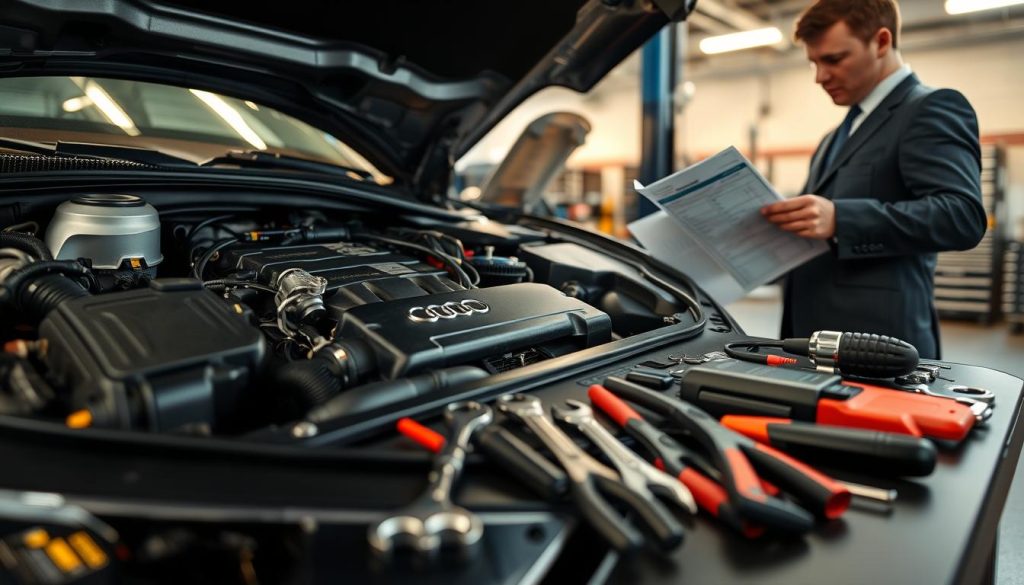
Turbocharged engines, all-wheel drive, and tight engine bays increase technician time. That extra time often adds more to a bill than the part price.
Access constraints and extra disassembly steps mean shop hours rise, even for routine repairs. Specialized diagnostics add billable time as well.
Premium parts and OEM expectations
Many shops recommend OEM or OEM-equivalent replacements to protect performance and resale value. That raises parts and replacement prices compared with mainstream brands.
Technology-heavy components
Systems like MMI, sensors, ECUs, and adaptive suspension are costly to fix or program. Repairs often require factory tools and software, which increases total repair costs.
Routine maintenance benchmarks
| Service | Typical US Range | Notes | When It Spikes |
|---|---|---|---|
| Oil change | $143–$250 | Premium oil and filters | Synthetic & dealer pricing |
| Brake pads | $300–$800 | Pads + machining or rotors | Performance models |
| Timing / major service | $1,000–$1,500 | Labor-heavy job | Older high-mileage cars |
| Transmission repair | $5,000+ | Major mechanical failure | Severe faults or rebuild |
Bottom line: engineering complexity + premium parts + advanced components combine to raise average ownership spend versus many mainstream vehicles. For service planning, see our dealer-level service guide for comparison and budgeting tips.
Audi vs Other Brands: How Maintenance Costs Compare Over Time
When you track annual service and repair totals, clear patterns emerge between mainstream and luxury brands.
Versus mainstream cars (Honda, Toyota): long-term totals tend higher. Expect greater per year spend driven by labor complexity and premium parts pricing. The gap often widens after warranty ends, when owners face full repair bills and must choose between dealership service or qualified independent shops.
German luxury peers
Compared with BMW and Mercedes-Benz, ownership totals are broadly similar. Each brand shows distinct profiles: some models demand more frequent electronic or drivetrain work, others have higher parts rates. Dealer labor rates — frequently debated in public forums with ranges cited near $220–$500+/hour — materially shift yearly bills.
Japanese luxury comparisons
Lexus and Acura typically show lower long-term costs. Better reliability trends and simpler service pathways reduce parts and repair frequency as vehicles age. That makes years three through ten more affordable for many owners.
- Decision lens: compare total maintenance + repairs over time, not a single service price.
- Ownership tip: choosing independent European specialists can cut bills while preserving performance and resale value.
Model Matters: Which Audi Vehicles Cost More to Maintain
Which model you pick often predicts how much you will spend on upkeep.
Entry-level vs higher-complexity models
The A3 averages about $741 per year, while an A4 Quattro sits near $925 per year.
The Q5 shows roughly $928 per year and about 1.2 repair visits per year, so owners see service more often.
Why numbers differ across models
All-wheel drive packaging, added weight, and turbocharged engines raise service time and parts needs. Quattro systems add labor and diagnostic steps that push repair costs higher for some vehicles.
Performance trims and premium repairs
S and RS models use stronger brakes, wider tires, and advanced cooling. Those components increase routine bills and the odds of higher-cost repairs after warranty ends.
- Compare A3 vs A4 Quattro vs Q5 averages when budgeting.
- For used buys, check maintenance records, oil change cadence, and past repairs.
- Remember: a model choice can change reliability and long‑term costs in a tangible way.
Conclusion
A realistic maintenance plan starts with a yearly baseline and adjusts for model specifics.
Use the $987 per year benchmark as a planning guide, not a guarantee. That figure blends routine maintenance and occasional repairs and will shift with condition, driving, and service history.
Higher bills usually come from labor complexity, premium parts, and advanced systems found in many luxury vehicles. Compared with mainstream brands, totals are higher; with German peers they often match, while some Japanese luxury models cost less over the years due to better reliability.
Practical steps: pick the right model, check maintenance records, follow factory intervals, set aside a repair fund, and consider reputable independent shops after warranty.
If you prize driving feel and premium design, this way of ownership may be worth it. If minimizing repairs is the main goal, other brands can fit better.
FAQ
What is the average annual maintenance and repair cost for Audi vehicles in the United States?
On average, ownership expenses for Audi models run higher than mainstream brands. Typical annual maintenance and repair costs fall in the $900–$1,500 range for non-performance models, while higher-mileage or performance variants often exceed $1,800 per year. Costs vary by model year, drivetrain, and local labor rates.
How does reliability affect total ownership costs for luxury vehicles?
Reliability drives repair frequency and severity. More frequent failures or complex fixes push costs upward. Regular service reduces long-term bills, but a poorly maintained German-engineered system can lead to pricey repairs for items like turbochargers, timing components, and AWD hardware.
Why do labor and complexity make service bills higher on German luxury cars?
German engineering often uses tight engine bays, turbo systems, and all-wheel-drive layouts that take more time to access and repair. That increases shop labor hours, which is a major part of repair invoices at both dealerships and independent specialists.
Do replacement parts cost significantly more for premium brands?
Yes. OEM parts for premium vehicles command higher prices than parts for mainstream makes. Factors include specialized components, stricter tolerances, and limited production runs. Using genuine parts keeps warranties intact but raises parts bills.
How much do technology-related repairs typically add to maintenance costs?
Modern control modules, infotainment units, sensors, and adaptive suspension pieces can be costly to diagnose and replace. A single sensor or ECU replacement may range from a few hundred to over a thousand dollars once parts and labor are included.
What are routine maintenance price benchmarks for oil changes, brakes, and fluids?
Routine items cost more than on a compact sedan. Expect synthetic oil changes between $120–$250 depending on engine size and oil type. Brake jobs, full fluid services, and multi-point inspections can each range from $300–$900 when done at a dealership.
How do Audi maintenance costs compare to Honda and Toyota over time?
Compared with mainstream brands like Honda and Toyota, maintenance and repair bills for premium vehicles are generally higher. Mainstream cars tend to have lower parts prices, simpler systems, and longer stretches between major services, lowering total cost of ownership.
How do Audi costs compare with BMW and Mercedes-Benz?
Audis often align with BMW and Mercedes in overall cost structure. Differences come down to specific models and engineering choices. Each brand has areas that are expensive to repair, so ownership costs are similar across these German luxury competitors.
Why are Lexus and Acura usually cheaper to maintain as the vehicle ages?
Japanese luxury brands like Lexus and Acura emphasize long-term reliability and lower-cost parts. They use proven platforms and simpler service procedures, which leads to fewer high-cost repairs and lower labor times as vehicles age.
Which Audi models are least expensive to maintain?
Entry-level models with simpler drivetrains generally cost less. Compact models with naturally aspirated engines and front-wheel-drive or basic Quattro setups tend to have lower routine and repair costs than larger, more complex SUVs and high-performance cars.
How do costs change between base A3 or A4 and Quattro-equipped or Q5 models?
Quattro all-wheel-drive systems add parts, labor, and potential repair points, increasing maintenance costs. SUVs like the Q5 have heavier components and often higher tire, brake, and suspension expenses than compact sedans.
Do S and RS performance models require substantially higher maintenance budgets?
Yes. Performance variants use stronger brakes, higher-output engines, and more specialized components that wear faster or cost more to repair. They often require premium fluids, more frequent service intervals, and pricier replacement parts.
Can independent shops reduce Audi ownership costs compared with dealerships?
Competent independent European specialists often charge lower labor rates and can source quality aftermarket parts. That can lower total bills while preserving vehicle performance. Choose shops experienced with German vehicles and verify warranties on parts and labor.
How can owners control maintenance costs without voiding warranties?
Follow the manufacturer’s scheduled maintenance, use approved fluids and parts when required, and keep detailed service records. For non-warranty cars, reputable aftermarket parts and independent specialists can cut costs. Always check warranty terms before deviating from dealer service.
Are extended warranties or prepaid maintenance plans worth it for premium cars?
Extended warranties and prepaid plans can offer predictability and peace of mind if you plan to keep the vehicle long term. Compare coverage, exclusions, and expected repairs against the plan cost to determine value for your model and driving habits.
How does reliability affect total ownership costs for luxury vehicles?
Reliability drives repair frequency and severity. More frequent failures or complex fixes push costs upward. Regular service reduces long-term bills, but a poorly maintained German-engineered system can lead to pricey repairs for items like turbochargers, timing components, and AWD hardware.
Why do labor and complexity make service bills higher on German luxury cars?
German engineering often uses tight engine bays, turbo systems, and all-wheel-drive layouts that take more time to access and repair. That increases shop labor hours, which is a major part of repair invoices at both dealerships and independent specialists.
Do replacement parts cost significantly more for premium brands?
Yes. OEM parts for premium vehicles command higher prices than parts for mainstream makes. Factors include specialized components, stricter tolerances, and limited production runs. Using genuine parts keeps warranties intact but raises parts bills.
How much do technology-related repairs typically add to maintenance costs?
Modern control modules, infotainment units, sensors, and adaptive suspension pieces can be costly to diagnose and replace. A single sensor or ECU replacement may range from a few hundred to over a thousand dollars once parts and labor are included.
What are routine maintenance price benchmarks for oil changes, brakes, and fluids?
Routine items cost more than on a compact sedan. Expect synthetic oil changes between 0–0 depending on engine size and oil type. Brake jobs, full fluid services, and multi-point inspections can each range from 0–0 when done at a dealership.
How do Audi maintenance costs compare to Honda and Toyota over time?
Compared with mainstream brands like Honda and Toyota, maintenance and repair bills for premium vehicles are generally higher. Mainstream cars tend to have lower parts prices, simpler systems, and longer stretches between major services, lowering total cost of ownership.
How do Audi costs compare with BMW and Mercedes-Benz?
Audis often align with BMW and Mercedes in overall cost structure. Differences come down to specific models and engineering choices. Each brand has areas that are expensive to repair, so ownership costs are similar across these German luxury competitors.
Why are Lexus and Acura usually cheaper to maintain as the vehicle ages?
Japanese luxury brands like Lexus and Acura emphasize long-term reliability and lower-cost parts. They use proven platforms and simpler service procedures, which leads to fewer high-cost repairs and lower labor times as vehicles age.
Which Audi models are least expensive to maintain?
Entry-level models with simpler drivetrains generally cost less. Compact models with naturally aspirated engines and front-wheel-drive or basic Quattro setups tend to have lower routine and repair costs than larger, more complex SUVs and high-performance cars.
How do costs change between base A3 or A4 and Quattro-equipped or Q5 models?
Quattro all-wheel-drive systems add parts, labor, and potential repair points, increasing maintenance costs. SUVs like the Q5 have heavier components and often higher tire, brake, and suspension expenses than compact sedans.
Do S and RS performance models require substantially higher maintenance budgets?
Yes. Performance variants use stronger brakes, higher-output engines, and more specialized components that wear faster or cost more to repair. They often require premium fluids, more frequent service intervals, and pricier replacement parts.
Can independent shops reduce Audi ownership costs compared with dealerships?
Competent independent European specialists often charge lower labor rates and can source quality aftermarket parts. That can lower total bills while preserving vehicle performance. Choose shops experienced with German vehicles and verify warranties on parts and labor.
How can owners control maintenance costs without voiding warranties?
Follow the manufacturer’s scheduled maintenance, use approved fluids and parts when required, and keep detailed service records. For non-warranty cars, reputable aftermarket parts and independent specialists can cut costs. Always check warranty terms before deviating from dealer service.
Are extended warranties or prepaid maintenance plans worth it for premium cars?
Extended warranties and prepaid plans can offer predictability and peace of mind if you plan to keep the vehicle long term. Compare coverage, exclusions, and expected repairs against the plan cost to determine value for your model and driving habits.