Upgrade your living room audio without overspending. This guide ranks a curated list of compact packages and soundbar-based setups that deliver true surround sound and clear dialogue. Expect real-world testing, easy setup tips, and notes on what works best for small and mid-size rooms.
Whether you stream movies, play music, or watch live sports, the right speakers make a big difference. We compare subwoofer impact, rear-speaker placement, and streaming compatibility like HDMI eARC and Bluetooth. You’ll see which soundbar combos balance bass, clarity, and convenience for a given price point.
Each pick emphasizes quick setup and minimal cables so first-time buyers can get great audio fast. We also flag timing tips and price-to-performance leaders so you can buy with confidence and get the best value.
Key Takeaways
- Find packages that match your room size and listening goals.
- Soundbar bundles often offer easy setup and solid bass with a subwoofer.
- True rear speakers boost immersion for movies and gaming.
- Look for HDMI eARC and Bluetooth for modern streaming needs.
- Placement matters: slight adjustments improve clarity and bass balance.
Why budget surround sound in 2026 makes sense for your living room
Upgrading TV audio in 2026 often means small, smart packages that punch above their price.
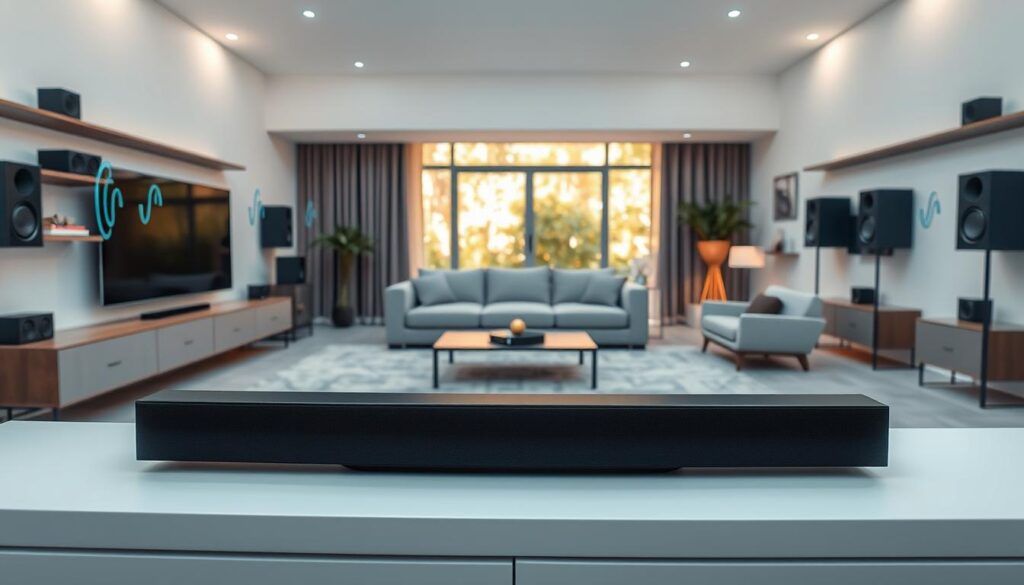
Affordable bundles now pair compact speakers and subwoofers to deliver true surround sound without bulky racks. That makes them ideal for a typical living room or apartment where space and simplicity matter.
Manufacturers focus on clear dialogue and impactful effects. You get better overall sound quality for film, sports, and music than most TV speakers can provide.
Modern units add smart connectivity and straightforward controls. This reduces setup time and keeps troubleshooting to a minimum for busy homes.
- Value: lower entry price with upgrade paths.
- Flexibility: designs that fit consoles or wall mounts.
- Tunability: modes that adapt to your listening space.
| Benefit | Why it matters | Who benefits |
|---|---|---|
| Compact form | Occupies less room and hides cables | Renters and small-home owners |
| Clear dialogue | Improves TV and streaming clarity | Movie watchers and sports fans |
| Expandability | Add rear speakers or wireless sub later | Budget-conscious buyers |
How to choose an affordable surround sound system without sacrificing quality
Start by deciding what you want most: crisp dialogue or a theater-like, immersive experience.
Key factors: channels, subwoofer and rear speakers
Match channels to your goals. A 2.1 or 3.1 bar plus subwoofer improves clarity and bass. A 5.1 or 5.1.2 package adds rear speakers and possible height effects for true surround.
Prioritize the subwoofer. Even entry units yield tight bass that won’t muddy dialogue. Look for controlled low end and a blendable crossover.
Choose real rear speakers when wraparound matters. Discrete rears place ambient effects behind you and make scenes feel more lifelike than virtual processing.

Room size, power needs and placement
Small rooms need modest power and compact speakers. Large rooms require higher output and bigger drivers to keep impact at distance.
Place fronts at ear level and rear speakers behind the seat. Position the subwoofer near a wall or corner for reinforcement without boom.
Price-to-performance: what affordable buys in 2026
Check tuning options: EQ presets, level trims for bass and surrounds, and night modes. Confirm HDMI eARC/ARC and stable wireless links for easy TV integration.
| Factor | What to check | Why it matters |
|---|---|---|
| Channels | 2.1, 3.1, 5.1, 5.1.2 | Determines clarity vs immersion |
| Subwoofer | Size, crossover, placement | Controls bass punch without muddying mids |
| Rear speakers | Wired vs wireless, placement | Creates true surround and depth |
| Power & room | Watts, driver size, room dimensions | Ensures consistent output at listening distance |
Dolby Atmos on a budget: what it is and when it matters
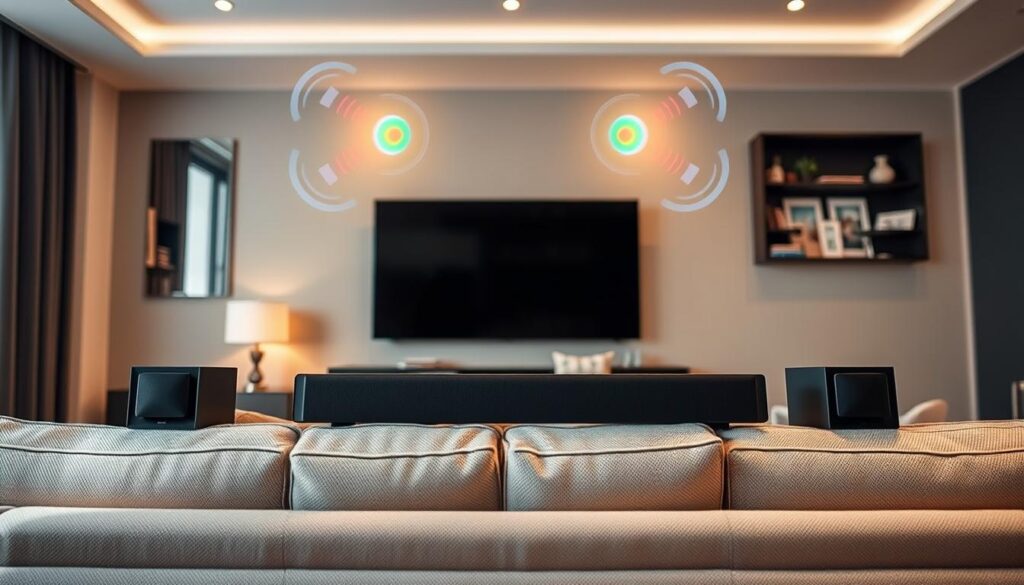
Dolby Atmos brings a vertical layer that can turn flat mixes into immersive scenes. It places effects above listeners so sounds move in three-dimensional space rather than just around you.
Height channels vs virtual processing
True height channels use up-firing or ceiling-mounted speakers to create real overhead reflections. Those drivers physically place audio above the listener for convincing overhead cues.
Virtual processing uses algorithms and speaker driver placement to simulate height. Many affordable 2.1 and 3.1 bars decode Atmos but render it virtually. That widens the stage but won’t match dedicated height speakers.
Content and streaming support in the United States
Major platforms now offer Atmos on select titles, but playback depends on both your streaming device and the system’s format support.
- Room matters: low, flat ceilings help up-firing drivers work; high or irregular ceilings favor virtual processing.
- Practical trade-off: prioritize tuning, subwoofer quality, and rear speakers if most content is stereo or 5.1.
- Label check: confirm whether the Atmos badge means real height drivers or simulated processing before you buy.
| Feature | Budget impact | When it matters |
|---|---|---|
| Discrete height channels | Higher cost, better realism | Large rooms and Atmos-native content |
| Virtual processing | Lower cost, wider stage | Small rooms or mixed content |
| Streaming support | Depends on app and device | Check platform titles and device passthrough |
Our methodology for selecting the 10 Best Cheap Surround Sound Systems to Buy in 2026
Our selection process relied on hands-on listening and practical setup checks in everyday rooms. We prioritized packages that deliver convincing surround staging and balanced sound across dialogue, effects, and music.
Usability guided many choices. We tested clear displays, easy app controls, and remotes so setup is fast and intuitive. That yields a better long-term listening experience.
Room realism mattered. We judged how each system performs in living rooms and apartments, not only in ideal test spaces. Placement flexibility and consistent performance at home were key.
Connectivity checks favored HDMI eARC/ARC and solid Bluetooth pairing. We also evaluated build quality, driver layouts, and heat behavior at higher volumes to gauge durability and value.

- Dialogue clarity tested with dramas and action mixes.
- Bass judged for control and extension, not just loudness.
- Both soundbars and compact speaker setups were compared for price-to-performance.
| Criteria | What we tested | Why it matters |
|---|---|---|
| Immersion | Rear speakers, Atmos cues, staging | Creates lifelike scenes for movies and games |
| Usability | Setup, app, remote, display | Fewer headaches and quicker enjoyment |
| Connectivity | HDMI eARC/ARC, Bluetooth | Simplifies hookup and streaming |
| Value | Price vs clarity and durability | Better long-term return on purchase |
Best overall value: Hisense AX5140Q 5.1.2 with wireless subwoofer and rears
If your priority is convincing Atmos imaging and plug-and-play setup, this Hisense bar makes a strong case. The AX5140Q ships as a full 5.1.2 package with real rear speakers and a wireless subwoofer, so you get true height cues and genuine rear presence without running long cables.

Why it stands out: immersive Atmos and real rear speakers
The bar and rears use up-firing drivers to add believable overhead effects. That helps Dolby Atmos mixes feel more three-dimensional than virtual-only approaches at this price. Sonically, the ensemble is loud, detailed, and keeps dialogue clear even when effects peak.
Connectivity and setup: HDMI pass-through, Bluetooth, Roku TV synergy
Connectivity is practical: an HDMI pass-through plus the TV connection and reliable Bluetooth for quick streaming. Roku-ready integration lets compatible Roku TVs expose audio settings and run a demo to confirm calibration. Setup is straightforward thanks to a clear printed manual and numbered cords.
Pros and cons at a glance
- Pros: true 5.1.2 Atmos, wireless subwoofer, real rear speakers, easy setup, Roku synergy.
- Cons: Bluetooth only (no Wi‑Fi), fixed bright display, unclear differences between surround EQ modes, slightly higher price than the prior model.
| Feature | Why it matters | Verdict |
|---|---|---|
| Height channels | Adds vertical placement for effects | Effective |
| Connectivity | HDMI pass-through and Bluetooth | Reliable |
| Ease of setup | Printed manual, labeled cords | Beginner-friendly |
Best under-$125 pick for small rooms: Sony HT-S100F soundbar
For tight living spaces where a full setup is impractical, the Sony HT-S100F gives a simple audio uplift that fits on a shelf or TV stand.
The HT-S100F is a basic, very affordable 2.0 soundbar that improves TV dialogue and general playback. Setup is quick and straightforward. Roku TVs can auto-detect the bar so you control volume with the Roku remote.
Notable touches: clear printed startup and user guides, multiple listening modes (Cinema, Voice, Music), and LED-only status indicators that require a quick reference at first.
Expect limited bass without a subwoofer. Pushing volume past moderate levels can make the top end feel harsh. There is no included HDMI cable, so plan for a small extra purchase.
What you trade off at this price
- Compact chassis that saves space but lacks deep bass.
- Good voice clarity for low-volume TV listening, especially in small rooms.
- Simple system with no wireless sub option or advanced tuning.
| Feature | Effect | Who benefits |
|---|---|---|
| Voice mode | Improves dialogue clarity | Bedroom and apartment viewers |
| Printed guides | Faster, less confusing setup | First-time buyers |
| No subwoofer | Reduced low-frequency impact | Those wanting deep bass |
Best under $200 with surround speakers: Ultimea Skywave F40 Boom SE
The Ultimea Skywave F40 Boom SE brings real rear channels and a wired sub at a near-entry price. It’s a Walmart-exclusive package that aims for genuine immersion rather than simulated effects. The two-piece soundbar snaps together for quick assembly, and a dimmable status display helps in dark rooms.
Real-world surround on a budget
Dialogue stays clear during action scenes, and the rear speakers create a true wraparound feel compared with front-only bars. The system’s surround staging feels roomy and engaging for TV and movies.
Wired sub/rear quirks and placement tips
The large subwoofer connects to the bar with a cable, which simplifies power but limits placement flexibility. Rear speakers are linked in a chain with a 6m cable, so plan routing for a tidy look.
- Quick setup: snap-together bar and labeled connections speed installation.
- Placement: try corner or near-wall sub placement for firmer bass without boosting gain too much.
- Modes: audition Xupmix with familiar content—its behavior is unclear until you test it.
| Feature | What to expect | Practical tip |
|---|---|---|
| Rear speakers | Real drivers for depth | Position behind listening area for best effect |
| Subwoofer | Wired, lighter bass than size suggests | Place near a wall or corner; small level boosts help |
| Remote & display | Crowded remote, dimmable status panel | Spend a few minutes learning buttons; reduce display brightness |
The Skywave F40 Boom SE delivers strong surround and clear dialogue for under $200, making it a top choice for apartments and budget-minded buyers who want real rear speakers. For a quick guide on speaker sizing and placement in vehicles that can inform cable routing and room thinking, see what size door speakers are in a 2010 Ford.
Best for dialogue clarity: Amazon Fire TV Soundbar Plus with subwoofer
For viewers who value speech intelligibility, this 3.1 package keeps voices anchored and natural. The dedicated center speaker places dialogue firmly at the front of the room so actors and hosts remain clear even during busy scenes.
Center-channel advantage for TV and movies
The center driver helps separate speech from effects, reducing the need to raise volume to catch words. This front-focused design improves playback for shows, news, and films where clarity matters most.
Usability notes: remote, LEDs and adjustments
The system ships with a clear printed manual that eases setup. Expect a cluttered remote layout and audio adjustments that announce levels aloud. There is no alphanumeric display; mode recognition relies on LED patterns.
- Simulated Dolby Atmos and DTS:X widen the stage without extra rear speakers.
- Subwoofer delivers tight, controlled bass that supports the midrange.
- Frequent discounts make the package a strong value for streaming-heavy households.
| Feature | Why it matters | Practical note |
|---|---|---|
| 3.1 center channel | Anchors dialogue at the front | Better clarity than many 2.1 bars |
| Simulated surround | Wider soundstage without rears | Works well in small to mid rooms |
| Subwoofer | Tight bass, controlled low end | Enhances impact without muddying vocals |
Best compact option for streaming-centric setups: Roku Streambar
The Roku Streambar combines a compact soundbar with a full Roku streaming player so you can cut one device and one remote from your living room layout. Setup is straightforward, and the quick-start guide walks you through HDMI and on-screen steps with a helpful demo.
Out of the box, the Streambar delivers clear, dialogue-forward sound that suits bedrooms and small apartments. Bass is limited because of the small cabinet. Adding the Roku Wireless Bass Pro subwoofer deepens low end and improves movie impact.
When to choose it, and how to expand with subwoofer and rear speakers
Pairing Roku Wireless Speakers as rear speakers creates a simple 5.1-style layout without complex wiring. That expansion boosts immersion while keeping setup fast.
- Space-saving: built-in streaming removes a separate player.
- Upgrade path: optional Roku subwoofer and wireless rears.
- Limitations: no HDR10+ or Dolby Vision support; note the original Streambar was discontinued late 2025, with Streambar SE remaining.
| Strength | Why it matters | Practical note |
|---|---|---|
| Integrated streaming | Fewer devices and remotes | Great for streaming-first homes |
| Dialogue clarity | Improves TV vocals and shows | Ideal for small rooms |
| Expandable | Add subwoofer or wireless rear speakers | Build toward fuller surround without hard wiring |
Best budget Atmos soundbar: Vizio SV210D-0806
The Vizio SV210D-0806 brings Atmos decoding into a compact, easy-to-place 2.1 package. It aims at buyers who want a wider soundstage without adding rear speakers.
Who it’s for: users with small living rooms or tight media stands who want some Dolby Atmos depth while keeping wiring and footprint minimal.
The bar features a rounded, cloth-covered design that looks more premium than many budget bars. Setup requires HDMI eARC since there is no optical input, so confirm your TV supports the protocol.
- Includes an HDMI cable and uses the Vizio app (WatchFree+) for settings; there is no physical remote.
- Processing widens the perceived stage but won’t match a multi-speaker system with discrete height drivers.
- Size and tuning favor clear dialogue and moderate bass reinforcement for everyday TV and movies.
| Feature | Why it matters | Practical note |
|---|---|---|
| Dolby Atmos | Adds vertical cues | Good for mixed content; not full-height realism |
| HDMI eARC | Passes high-rate formats | Required — no optical input |
| Design | Blends with modern decor | Compact for stands and wall mounts |
More smart-value contenders to complete your top ten
Look past headline models: many value-minded soundbars and compact systems under $250 deliver usable upgrades for everyday TV rooms.
Solid alternatives under $250
Seek packages that include a subwoofer or offer one as an add‑on. Bass reinforcement is the fastest way to lift movie impact without re-tuning your whole setup.
Check whether the bar supports HDMI eARC or ARC for smoother TV hookup and better lip-sync. Good app support or an on-bar display makes firmware updates and fine-tuning painless.
What to check: bass performance, HDMI eARC, app support
- Confirm rear speaker support and note wired vs wireless options for placement planning.
- Compare printed quick-start guides; clearer instructions speed setup and cut frustration.
- Test Bluetooth pairing stability if you stream often from a phone or tablet.
- Watch price trends—holiday sales often drop sub-$250 models significantly.
| Feature | Why it matters | Practical tip |
|---|---|---|
| Subwoofer option | Adds low-end and movie impact | Prefer systems with optional wireless subs |
| HDMI eARC/ARC | Simpler TV control and pass-through | Use eARC when available for best formats |
| App/display support | Easier updates and tuning | Choose brands with clear apps and readable displays |
| Remote/usability | Daily convenience | Test button layout and switching speed |
Surround vs soundbar systems: which fits your room, setup and budget
Deciding between a multi‑speaker kit and a single bar hinges on how immersive you want your movies and how much space you can spare.
Choose a full surround system with true rears if you want the most convincing wraparound effects and can accommodate extra speakers and cables. True rears place effects behind you for lifelike immersion.
Opt for a single soundbar when space is tight or you prefer minimal setup. Many bars still deliver clear dialogue and a wide front stage that greatly upgrades TV audio in a small home.
- Hybrid paths—bars with optional rears—let you start simple and expand later.
- Narrow rooms often favor compact bars; wider rooms benefit from discrete rears.
- Consider long‑term costs: expansion subwoofers and extra speakers add to the initial price tag.
| Choice | Strength | When to pick |
|---|---|---|
| Full surround | Best placement behind listener | Dedicated media rooms |
| Soundbar | Simple, compact, good dialogue | Renters, small living rooms |
| Modular | Growable, flexible | Uncertain budgets or evolving needs |
Tip: use HDMI eARC/ARC so your TV remote controls volume and simplifies daily use, no matter the path you choose.
Connectivity checklist: HDMI eARC, optical, Bluetooth and streaming support
A clear hookup plan makes it simple to preserve high-quality audio and avoid lip-sync issues.
Favor HDMI eARC for the most reliable audio return and remote control. eARC passes higher-bandwidth formats and keeps your TV remote working with the system. Use certified high-speed HDMI cables for eARC runs to reduce dropouts.
If your TV lacks eARC, HDMI ARC still helps, but confirm format support and whether lip-sync controls exist. Optical works for basic stereo and some surround, yet it won’t carry many Atmos streams from apps.
Ensuring lip-sync and Atmos passthrough
Set both TV and bar to pass through or bitstream for Atmos where available. Some packages decode Atmos but render it virtually; test with known content to confirm real passthrough.
- Check for adjustable audio delay on TV and bar to fix lip-sync.
- Confirm streaming paths: if the bar lacks Wi‑Fi, rely on your TV or a streaming device; use Bluetooth for quick phone playback.
- Verify Bluetooth version and codec support—real-world reliability varies by implementation.
- Keep firmware current via app or USB so format updates and fixes apply.
- Prefer clear input labeling and fast switching when multiple devices share the TV.
| Connection | What it carries | When to use |
|---|---|---|
| HDMI eARC | High-bandwidth audio, control | Primary hookup |
| HDMI ARC | Compressed surround, control | Fallback |
| Optical | Stereo/older surround | Legacy TVs |
Need help fixing odd audio behavior? See this guide on how to fix audio issues for practical troubleshooting steps you can adapt to home setups.
Subwoofers, bass and neighbors: getting low-end right in limited space
How you place and tune a subwoofer matters more than its driver size. Start with a moderate position near a wall or corner to get reinforcement without a boomy, neighbor-annoying thump.
Use level and crossover controls to blend the subwoofer so it supports the mains and keeps dialogue clear. Sit in your main listening spot and fine-tune by ear with familiar content.
Reduce vibration with isolation pads or risers to cut structure-borne noise in apartments. If the sub is wired to the bar, plan cable routing early to avoid trips and keep placement flexible.
Try night modes or dynamic range compression for late viewing. Smaller rooms respond better to controlled, quick bass than sheer output; enclosure tuning and room interaction shape perceived weight more than raw driver size.
- Re-check levels after moving furniture or rugs—room changes alter response.
- Prioritize systems known for tight, musical bass in multi-unit homes.
| Action | Why it matters | Quick tip |
|---|---|---|
| Corner/wall placement | Reinforces low end without large gain | Move a few feet and listen for boom |
| Level & crossover | Blends subwoofer with mains for clear audio | Lower crossover until bass and mids match |
| Isolation | Limits vibration through floors | Use pads or risers in apartments |
| Night modes | Tames peaks that bother neighbors | Enable for late-night viewing |
Rear speakers and height channels: placement, mounting and calibration
Good rear placement and careful height alignment make the difference between a flat mix and an immersive home theater. Follow simple rules for positioning, mounting, and tuning so your setup yields consistent surround imaging and believable overhead effects.
Up-firing vs true height: practical tips
Place rear speakers slightly behind and to the sides of your seating position at ear height when possible. Aim them toward the listening area for cohesive surround and a stable phantom center.
For up-firing height channels, prefer low, flat ceilings so reflections reach listeners cleanly. Avoid vaulted or absorptive ceilings that scatter height cues and weaken perceived elevation.
True height (ceiling or wall-mounted) gives the most convincing overhead effects but takes more work. Mounting and precise aiming matter; even small level mismatches can break immersion.
- Keep speaker distances symmetrical to preserve imaging.
- Plan cable runs along baseboards or under rugs for neat, safe installation.
- Do not block up-firing drivers with furniture or shelves.
- Use test tones or a calibration track to set relative channel levels.
- Recheck calibration after moving furniture, rugs, or seats.
| Item | Action | Quick tip |
|---|---|---|
| Rear speakers | Aim slightly inward behind seating | Mount at ear height if possible |
| Up-firing height | Use with low flat ceilings | Avoid heavy absorption above |
| Calibration | Set levels with test tones | Adjust after room changes |
Setup made simple: quick-start steps for a smoother first-time experience
A focused setup plan saves time and makes your speakers and bar sound their best right away.
Unbox first. Lay out the bar, subwoofer, any rear speakers, power cords, and an HDMI cable for eARC/ARC. Confirm all parts before you start.
- Connect the soundbar to the TV’s HDMI eARC/ARC port, then power on the system so automatic pairing can link the sub and rears if they are wireless.
- Center the bar under the TV with drivers unobstructed. Place the sub near a wall and set rears slightly behind the seating area for balanced sound.
- Run any on-screen setup or guided quick-start steps. Select an audio mode and verify channel output using test tones or a demo clip.
- Adjust subwoofer level and dialogue enhancement to taste. Aim for clarity and impact without masking mids.
- Set the TV’s audio output to bitstream or passthrough when available and disable TV speakers to avoid echo.
Label inputs in the bar’s app or display for easy switching between TV and Bluetooth. Update firmware if prompted to improve stability and add features. Tidy cables with clips or raceways and save your final settings; many systems remember per-mode levels for faster tweaks later.
| Step | Why it matters | Quick tip |
|---|---|---|
| Identify components | Prevents missing parts and delays | Check cords and HDMI before discarding packaging |
| HDMI eARC connection | Allows high-quality audio passthrough | Use the TV’s eARC port and a high-speed cable |
| Placement & pairing | Optimizes imaging and bass | Center bar, sub near wall, rears behind seats |
| Calibration & updates | Ensures best sound and reliability | Run guided setup, then update firmware |
Price watch and buying timing: how to score the best deals in 2026
Timing your purchase can turn a routine sale into a major upgrade for home audio. Watch major sale periods — New Year events, spring promos, back-to-school, and holiday weekends — when prices on soundbars and compact systems often fall below list.
Use deal trackers and historical price tools to spot true discounts versus temporary markdowns. Set alerts for the models on your shortlist so you catch a genuine drop fast.
Consider certified refurbished and open-box options from trusted retailers to stretch budget without losing warranty support. New model launches also push prior-year units down in price while keeping solid sound performance.
- Bundles with a subwoofer or rear speakers usually offer better value than buying add-ons later.
- Verify return windows and exchange policies so you can test the gear at home and swap if it fails to match your room.
- Compare total checkout costs — shipping and taxes can change the final prices significantly.
- Check retailer-exclusive models; they sometimes share internals with mainstream versions but include extras or lower price tags.
- Read recent buyer feedback to confirm no wide issues that would cancel out a deal’s value.
| Action | Why it matters | Quick tip |
|---|---|---|
| Track prices | Find real discounts | Use alerts for your short list |
| Buy open-box/refurb | Stretch budget with coverage | Confirm retailer warranty |
| Bundle purchases | Save on add-ons | Prefer packs with sub or rears |
A little patience and tracking often secures a higher-tier audio experience for the same budget. Plan, compare final costs, and test return policies before you commit.
Conclusion
, Smart choices in speakers and placement deliver dramatically better movie and music playback with minimal fuss. Pick gear that fits your room and habits and you’ll notice clearer dialogue and tighter bass right away.
Our picks balance reliable operation and impactful sound so setup feels fast and rewarding. Prioritize the features that matter—dialogue clarity, bass control, or true surround sound—and match them to your daily use.
With a few level tweaks and smart placement, even modest packages can fill a room and lift your viewing experience at home. Track seasonal deals and test in your space so the final system fits both budget and taste.