Electricity powers most modern devices, and simple paths let current flow through parts. This guide lays out clear definitions, basic math, helpful diagrams, and hands-on examples for anyone learning circuits.
A single-path setup links components end-to-end so current stays the same while voltage divides and resistance adds. That rule set makes this layout easy to analyze but also creates a key weakness: one failed part can stop the entire chain.
Expect practical references to old-style holiday light strings and flashlight battery stacks. The article also contrasts this layout with parallel wiring and shows mixed combinations used in real designs. Readers will get step-by-step examples, correct terminology, and quick troubleshooting cues to use right away.
Key Takeaways
- Clear scope: definitions, calculations, diagrams, practical uses.
- Single-path flow keeps current constant; voltage splits across parts.
- Total resistance equals the sum of individual resistances.
- Simple to analyze but vulnerable to one-part failure.
- Real examples: classic light strings and stacked batteries.
- Guide compares single-path wiring with parallel and mixed systems.
Series Circuits in Today’s Electronics and Everyday Life
Controlled electrical paths let designers send power where it’s needed in devices big and small.
Simple paths keep current predictable. That predictability helps engineers teach basic principles and lets technicians measure voltage and resistance with confidence.
Many everyday gadgets use these layouts in part. Portable devices, classroom lights, and some battery-powered tools rely on single-path sections to deliver steady power from the source.
Learning labs favor this setup because one path makes behavior easy to predict. In modern product design, a single-path element often appears as current limiting or as a safety interlock inside more complex systems.
- Why care: spotting that segment helps you analyze voltage drop, current flow, and total resistance.
- Real practice: stacked batteries and some light strings use single-path wiring to reach higher voltages or simple control.
To dive deeper into related warnings and indicators for vehicle lights, see this car warning lights guide. Later sections show core calculations for total resistance and voltage division so you can apply these ideas in practical electronics.
What Is a Series Circuit?
Definition: A series circuit links components end-to-end so the electric current travels one continuous loop from the source, through each component, and back to the source.
Analogy: Think of a chain, a domino line, or a single-lane road: every item shares the same track, and a break anywhere stops the entire circuit.
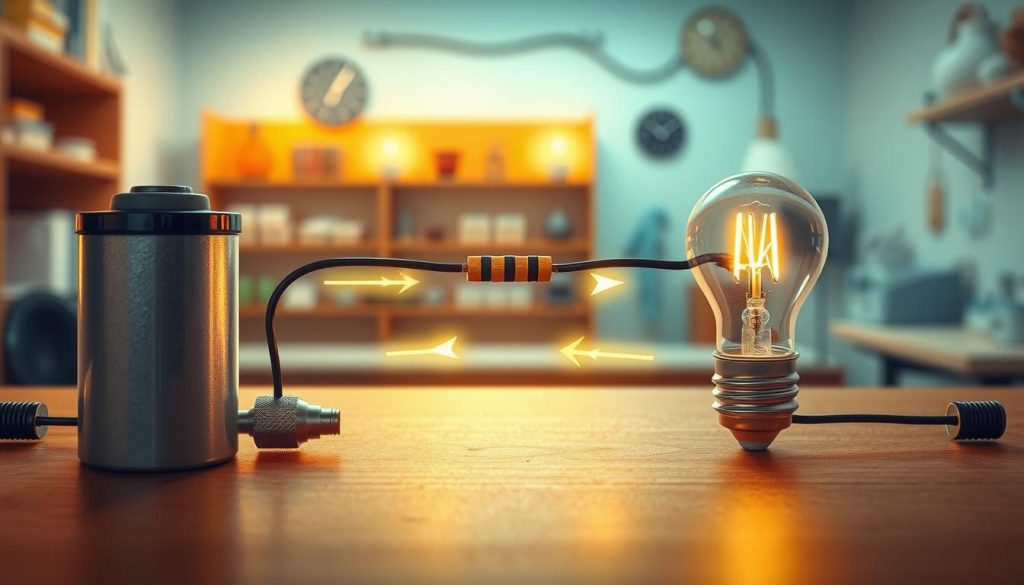
Operationally, the loop must be continuous. If one component opens, current stops everywhere. Component order does not affect the fact that the same current flows through each element when the path is closed.
- Key terms to use later: component, path, loop, source, load.
- Every component shares identical current; interruption changes behavior across the entire circuit.
Next, the single path directly determines how current flows in series circuits and how resistance or a failed element alters that flow.
How Current Flow Works in a Series Circuit
With only one route for electrons, each component sees the same steady current. That single-route design makes behavior simple to predict without splitting the flow.
Why the same current passes every element
One path means one path only. Electrons have no alternate route, so the current through each component matches the current at every other point.
- The lack of branches prevents the current from dividing.
- Uniform current makes measurement and analysis straightforward.
How increasing resistance changes flow
When total resistance rises, the overall current falls for a fixed source voltage. Higher resistance reduces the flow through every component, so devices may dim or stop working.
When one component fails
An open circuit happens when a component breaks its path. Think of a single-lane road: a blocked lane stops all traffic. If one component fails open, current drops to zero through the entire circuit.
Note: not every fault is open; shorts can cause different symptoms and are covered later in troubleshooting.
| Condition | Effect on current | Visible sign |
|---|---|---|
| Normal | Steady, uniform current | All devices operate |
| Increased resistance | Reduced current | Dim lights, reduced performance |
| One component fails (open) | Zero current in entire circuit | Everything stops working |
Voltage in Series Circuits: Total Voltage and Voltage Drop Across Components
Think of voltage like a budget shared by items in one loop. Each resistor takes a portion based on its size. That share determines how much energy each device receives.
How the source voltage divides
The total voltage from the source gets split among resistors in line. A larger resistor gets a larger voltage drop across it. In simple terms, higher resistance produces a bigger share of the supply.
Voltage across vs. voltage drop across
Use “voltage across” to describe the reading between two terminals. Use “voltage drop across” when emphasizing energy lost by current through that element. Both refer to the same measurement but differ by context.
Kirchhoff’s Voltage Law made practical
In one closed loop the individual drops add to the total voltage. The arithmetic sum of every voltage drop equals the supply voltage. That rule helps predict behavior and design safe chains of resistors.
- Resistors series create a predictable divider; this previews later calculations.
- Probe across a component with a multimeter to read its voltage across terminals.
- Practical note: many bulbs in line dim because too much voltage drop occurs before they get power.
Total Resistance in Series Circuits
Treat multiple resistors in line as one equivalent resistor when computing circuit behavior.
The core rule: total resistance equals the sum of all resistances placed in the single path. In formula form that reads R_total = R1 + R2 + R3 … .
Why do resistances add? Each resistor acts as an extra obstacle to electron flow. Placing resistors in the same route makes the obstacles cumulative, so the circuit sees one larger resistance value.
Quick calculation example: add 2 Ω, 3 Ω, and 5 Ω. The total is 2 Ω + 3 Ω + 5 Ω = 10 Ω. That single value replaces the three resistors for system-level analysis.
As total resistance increases, current falls for a fixed source voltage. Once R_total is known, use Ohm’s Law to find current easily.
Practical check: if adding components in line causes current to rise instead of fall, suspect miswiring or a short bypassing one resistor.
| Item | Value (Ω) | Role |
|---|---|---|
| Resistor 1 | 2 | Small obstacle |
| Resistor 2 | 3 | Medium obstacle |
| Resistor 3 | 5 | Largest obstacle |
| R_total (sum) | 10 | Equivalent resistance |
Ohm’s Law in a Series Circuit
Ohm’s Law provides the simplest bridge between volts, amps, and ohms when parts line up in one path. Use the relation V = IR to link supply voltage, circuit current, and total resistance.
Using V = IR for the entire circuit
Step 1: Add resistances in line to get R_total. For a 12 V battery with 2 Ω and 3 Ω, R_total = 5 Ω.
Step 2: Apply V = IR at the whole level. I = 12 V ÷ 5 Ω = 2.4 A. That one current flows through every element.
Using V = IR at each component
With the uniform current known, compute the voltage drop across each resistor using V = I × R. The same current value multiplies each resistor value to give its drop.
Worked example: 12 V battery with 2 Ω and 3 Ω
R_total = 2 Ω + 3 Ω = 5 Ω. Current through the chain is 2.4 A.
Voltage drop across the 2 Ω resistor: V = 2.4 A × 2 Ω = 4.8 V.
- Check: drop across 2 Ω (4.8 V) plus drop across 3 Ω (2.4 A × 3 Ω = 7.2 V) sums to the battery voltage (4.8 V + 7.2 V = 12 V). This verifies Kirchhoff’s rule.
- Design takeaway: once current is set, predict power and brightness, but verify component ratings to avoid overheating.
Series Circuit Diagram Walkthrough
A simple schematic makes it fast to spot the battery, bulb, and resistors arranged in one line.
Reading a simple diagram: battery, wires, resistors, and a light bulb
Start by locating the source. The battery symbol marks where voltage begins and returns.
Next find the straight lines that act as wires. They link every component in one continuous loop.
Identify each load: two resistors and a light bulb sit in line. Label them so calculations are easier.
Identifying the single path and the order of components
- Trace the path from the battery positive, through each component, back to the negative terminal.
- Confirm there are no branches; one route means the same current flows through every element.
- Order shown left-to-right or top-to-bottom does not change current, only where you analyze first.
- Good habits: mark nodes, note R values, compute total resistance, then find current and each voltage drop.
| Symbol | Example | Role |
|---|---|---|
| Battery | Cell pair | Voltage source |
| Resistor | R1 = 2 Ω, R2 = 3 Ω | Limit current / voltage drop |
| Light bulb | Incandescent bulb | Load that converts power to light |
Real-World Series Circuit Examples
Everyday gadgets often hide simple chains that show how current behaves when parts link end-to-end. These practical cases make abstract rules easy to test at home.
Old-style holiday lights: Many classic light strings use one path through each lamp. When one bulb’s filament opens, the path breaks and the entire string goes dark. That single broken bulb creates an open in the loop, so current cannot flow to any other lights.
Flashlights with stacked batteries: Cells placed in line add their voltages together to raise usable voltage for the lamp. Stacking does not increase amp-hour capacity, so runtime depends on each cell’s rating, not the added voltage.
Fuses and switches in line: Designers put protection and controls in the same path as the load so every amp passes through them. A fuse is chosen to fail open on overload to stop current and reduce fire risk. Switches provide reliable on/off control for devices.
| Example | Why series used | Practical note |
|---|---|---|
| Holiday lights | Single path keeps wiring simple | One failed bulb stops all lights |
| Flashlight | Cells add voltage for brighter lamp | Voltage up, capacity unchanged |
| Fuse / Switch | All current goes through protection | Designed to open under fault to protect power path |
What is a Series Circuit? Advantages, Disadvantages and Examples
In a single-path wiring layout, every component shares identical current, which keeps behavior easy to predict.
Benefits: The layout has a clear, compact form with fewer branches to trace. That makes calculations for voltage drop and total resistance quick.
Predictability helps in education and basic builds. With one steady current value, computing each component’s voltage and power becomes straightforward.
Key drawbacks and design trade-offs
- Single point failure: If one component opens, the whole loop stops. That makes this layout poor for critical systems that must stay on.
- Voltage division: Adding parts reduces the voltage each device sees. That can limit brightness, torque, or other performance metrics.
- Limited scalability: With more loads in line, available power per device falls unless the source voltage rises.
There are times when the all-or-nothing nature is useful. Safety interlocks, fuses, and simple switches often use this trait so any open condition halts operation.
| Feature | When useful | Practical note |
|---|---|---|
| Simple layout | Teaching, prototypes | Easy to analyze and debug |
| Single failure stops flow | Safety interlocks | Not suited for continuous-operation systems |
| Voltage split among loads | Low-cost lamp strings | May require higher source voltage for adequate device power |
These limitations explain classic light-string behavior and the use of series protection devices. Many practical systems move to parallel wiring to keep devices working when one branch fails, which we cover next.
Series vs Parallel Circuits
Contrasting one-route designs with multi-route setups highlights how current and voltage distribute in each case.
Single path vs multiple paths: the defining difference
Single path wiring links parts in one continuous loop so every element shares the same current. By contrast, parallel circuits create multiple paths between the same nodes, forming separate branches for current to travel.
Current behavior
In a single route the current is identical at every point. In a parallel circuit the supply splits, and each branch carries its own portion of the current.
Voltage behavior
When parts sit in line the source voltage divides among them. With parallel wiring the voltage across each branch stays the same as the source, so devices see equal voltage.
Reliability comparison
Reliability differs sharply: if one component fails in a series loop the whole chain stops. In a parallel arrangement one failed branch leaves the other branches working, so the system continues to operate.
- Household wiring uses parallel circuits so one light or appliance turning off does not darken the house.
- Engineering trade: parallel improves robustness but requires more wiring and elevates total current demand on the source.
- Many devices use mixed layouts to balance voltage needs, current limits, and uptime.
| Feature | Series | Parallel |
|---|---|---|
| Path | One continuous route | Multiple branches |
| Voltage | Divided among parts | Same across each branch |
| Failure impact | Entire loop stops | Other branches keep working |
Series-Parallel Circuits and When to Use Them
Combining chained components with parallel branches lets engineers tune voltage and uptime together. Hybrid layouts place some parts in-line to share current while other portions split into parallel paths to keep voltage consistent across multiple loads.
How hybrids merge uniform segments with split paths:
Uniform current segments meet parallel branches
In many designs, a series string sets a predictable current or creates a voltage reference. That string then feeds several parallel branches so each branch sees the same supply voltage.
Where hybrids appear in electronics
Battery packs often join cells in series for higher voltage, then place parallel groups to raise capacity and redundancy. LED fixtures use series LED chains to hit forward-voltage targets, then wire multiple chains in parallel for brightness and fault tolerance.
When analyzing these networks, reduce each part to an equivalent: sum resistances for series segments, compute parallel equivalents for branches, then combine results. This approach makes total current and voltage distribution predictable.
- Design takeaway: use hybrids to balance brightness, runtime, and fault tolerance.
- Reduce complex layouts to simpler equivalents before applying Ohm’s Law.
| Use case | Why hybrid helps | Practical note |
|---|---|---|
| Battery pack | Voltage scaling and capacity | Series raises volts; parallel raises amp-hours |
| LED array | Voltage match plus redundancy | Series strings keep uniform current; parallel strings share load |
| Power modules | Control and safety | Series elements limit current; parallel branches supply multiple outputs |
Troubleshooting and Failure Modes in Series Circuits
Troubleshooting often starts where the wiring stops: at the point that no longer lets current flow. Begin by remembering one simple fact: a single open turns the entire circuit inactive.
Open-circuit behavior: when a component fails open, resistance becomes effectively infinite and current drops to zero. With no current, the rest of the loop has no voltage drop, so the full source voltage appears across the open segment.
Step-by-step diagnostic approach
- Verify source: confirm supply voltage at the terminals.
- Check continuity around the loop with a meter to find where current stops.
- Isolate individual components to locate the open element and replace or repair it.
Common mistakes and other failure modes
- Shorts reduce resistance, raise current, and may cause overheating.
- Bypass wiring around one component changes equivalent resistance and alters expected voltage drop readings.
- Loose connections add hidden resistance; unexpected voltage drop at a contact often points to that fault.
Quick diagnostic example
Imagine a lamp string that goes dark. You measure full source voltage at a junction. That reading suggests the open lies beyond that point. Isolate each lamp until continuity returns to identify the failed component.
| Symptom | Likely cause | First check |
|---|---|---|
| No current in entire circuit | Open component | Measure source voltage across suspect gap |
| High current / hot wiring | Short | Inspect for bypassed component or damaged insulation |
| Dim load | Unexpected voltage drop (loose contact) | Probe connections for added resistance |
Conclusion
Quick takeaway, a series circuit uses one continuous loop so the same current flows through every component. This simple layout makes analysis direct; trace the loop, sum resistances, then compute drops.
Three rules to keep: current stays equal at all points; total resistance equals the sum of each resistor; individual voltage drops add up to the supply voltage. Use these rules to predict behavior before probing with a meter.
Practical impact: the design is predictable but fragile—one open stops the whole circuit, and voltage division can limit device performance. Think holiday light strings, stacked flashlight cells, and inline fuses or switches.
Learning about series circuits builds the foundation needed to analyze parallel networks and hybrid layouts confidently. Apply these basics to troubleshoot, design, and scale circuits with purpose.
FAQ
What defines a series connection and how does it differ from parallel?
A series connection links components end-to-end so current follows one continuous path. In contrast, a parallel setup provides multiple paths so current splits among branches. Series forces identical current through every device; parallel keeps the same voltage across each branch.
Why does the same current flow through every component in a single-path circuit?
With only one route for charge carriers, there is nowhere else for current to go. Electrons that pass through one resistor must continue through the next, so the current magnitude remains equal at every point in the loop.
How does total resistance behave when resistors are connected end-to-end?
Total resistance equals the sum of individual resistances. Adding 2 Ω, 3 Ω, and 5 Ω in series yields 10 Ω. That higher resistance reduces circuit current for a given source voltage.
How is source voltage distributed across resistors in this arrangement?
The source voltage divides among resistors in proportion to their resistances. Each resistor’s voltage drop equals I × R, and all drops sum to the total source voltage, as stated by Kirchhoff’s Voltage Law.
How do you apply Ohm’s Law to find current and individual voltage drops?
First compute total resistance (sum of R). Use V = IR with the source voltage to find circuit current. Then calculate each drop using Vdrop = I × Rcomponent. Example: a 12 V battery with 2 Ω and 3 Ω gives I = 12 / (2+3) = 2.4 A; the 2 Ω drop = 4.8 V.
What happens when one component fails open in this type of circuit?
An open component breaks the single path and stops current flow everywhere. The entire circuit becomes inactive; devices like bulbs have no current and go dark. The full source voltage may appear across the open segment during diagnosis.
How do fuses or switches function when placed in series with a load?
Fuses and switches control or protect the load by being part of the single path. A fuse opens under overload to protect devices; a switch opens or closes the path to turn the circuit off or on. Placing them in series ensures they interrupt current to the entire load.
Why did old-string Christmas lights all go out if one bulb failed?
Older strings wired each bulb in series. A single broken filament created an open circuit, stopping current to every bulb. Modern designs use parallel or shunted bulbs to prevent total outage when one lamp fails.
When do designers combine series and parallel elements in electronics?
Designers use hybrids when they need controlled current through specific segments while providing redundancy or shared voltage elsewhere. Power distribution, speaker arrays, and many circuit boards mix series resistances with parallel branches for performance and reliability.
How can you troubleshoot an open in a single-path wiring layout?
Use a multimeter to check continuity. If current is zero, measure voltage across suspected segments; a full source voltage across one section indicates an open there. Inspect connectors, switches, and solder joints for physical breaks or corrosion.
What are practical pros and cons of using a single-path arrangement?
Pros include simplicity, predictable current, and easy calculation of drops. Cons include total loss of function if any component opens and limited ability to supply different voltages to multiple devices without additional components.
How does increasing one resistor affect circuit current and power distribution?
Raising one resistor increases total resistance, reducing overall current. That lowers power in other components and increases the voltage drop and power dissipation across the larger resistor, which can affect device performance and thermal limits.