This intro maps the X3’s multi‑continent production story and gives a clear answer to the central question. The model has been built since 2003, evolving from an early Austrian contractor to a global program run by the bmw group.
The program now spans plants in the united states, South Africa, and China. Spartanburg in South Carolina is the core hub for North America. Other sites, like Rosslyn and Dadong (Shenyang), cover region‑specific variants and plug‑in or long‑wheelbase needs.
Design and technology trace back to 3 Series roots while modern platforms keep quality consistent across locations. The iX3 brings full electrification into the lineup, showing how the models extend into EVs.
By year and over the years, production shifted to match demand and regulation. This piece previews plant roles and explains why supply, logistics, and customer preference drive where each vehicle is built.
Key Takeaways
- The X3 program began in 2003 and now runs on three continents.
- Spartanburg serves North America; Rosslyn and Shenyang handle regional variants.
- Platform design and shared technology ensure consistent quality.
- The iX3 adds a battery‑electric option within the vehicle family.
- Production choices reflect market rules, logistics, and customer demand.
Where Are BMW X3 Made and Assembled?
From a single Austrian contractor the program grew into a global manufacturing footprint. The lineup now comes from purpose-built plants across three regions to meet demand, regulations, and local tastes.
Global footprint at a glance: U.S., South Africa, and China
The bmw group builds the model family in the united states for north america at Spartanburg, in south africa at Rosslyn, and in China through BMW Brilliance facilities. Each plant handles specific variants so logistics, tariffs, and market rules are managed locally.
Generational context: From E83 to G45 and iX3
The first generation (E83) was produced by Magna Steyr in Graz from 2003 to 2010. Production moved to Spartanburg for the F25 era, and later expanded with the G01 and current G45 to Rosslyn and Dadong/Shenyang.
Rosslyn added roughly 76,000 units of annual capacity when it took over portions of the program, complementing Spartanburg output. A China-only long-wheelbase variant is built at BBA’s Lydia plant to match local rear-seat preferences.
- Multiple plants increase resilience and speed regional delivery.
- The iX3 uses different supply chains and is not built at every site.
- Shared platforms let bmw models keep consistent quality across locations.
Big picture: the production strategy evolved from single-site contracting to a coordinated global network that supports the model family’s role as a key sports activity vehicle in major markets.
Plant Spartanburg, South Carolina: The Core of X3 Production for North America
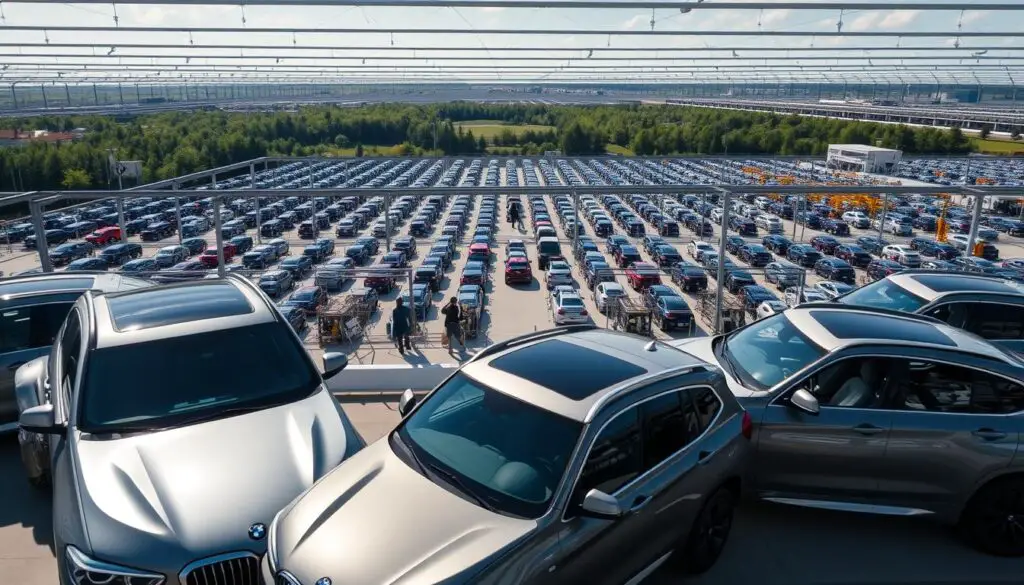
A major investment in Spartanburg turned the site into the go-to center for X model stamping and assembly.
New press shop and North American debut. A recent press release marked the launch of a state-of-the-art press that stamped the four doors, fenders, lift gate, and exterior body sides for the new X3 during its North American debut.
Local-for-local press capability
The spartanburg plant follows a local-for-local approach by producing critical body part sets on-site. The five-station servo press line with a crossbar feeder runs up to 18 strokes per minute. The coil line cuts blanks at up to 70 strokes per minute.
Quality controls and sustainability
Inspectors use special lights that mimic natural daylight to spot surface flaws before body integration. Scrap consolidation can reach roughly 50 tons per day for recycling.
| Capability | Detail | Impact |
|---|---|---|
| Press configuration | Five-station servo press + crossbar feeder | Precise forming, higher part output |
| Production rates | Up to 10,000 parts/day; coil line 70 spm | Consistent body quality |
| Workforce & scale | 11,000+ employees; 1.7M units since 2010 | Reliable output and talent pipeline |
| EV roadmap | All-electric activity vehicle assembly from end of 2026 | Shorter battery logistics via Woodruff supply |
The plant spartanburg upgrades tie technology and automation to better panel fit, quieter cabins, and durable body structures. The BMW Group expects at least six fully electric vehicles to be built in the U.S. by 2030, with high‑voltage batteries supplied locally to improve control and reduce transit time.
Plant Rosslyn, South Africa: Key Role for PHEV and Global Supply
Plant Rosslyn has been repurposed to support electrified variants and flexible regional output.
Rosslyn in south africa is the exclusive home of the plug‑in hybrid xDrive 30e. The site started G45 production after major upgrades and now focuses on the PHEV allocation that matches emissions strategies and market demand.
PHEV xDrive 30e built exclusively in South Africa
The plant’s supply chain is ready for high‑voltage components and battery integration. That readiness makes Rosslyn the logical center for the hybrid model while Spartanburg keeps its North American focus where the PHEV is not offered.
Annual output and capacity evolution since the 3 Series handover
Since the handover from 3 Series work, investments raised capacity to roughly 76,000 units a year. Process upgrades added flexible scheduling so vehicles can be routed to multiple regions without delay.
- Process engineering and supplier base support tight engine and e‑motor integration.
- Diesel powertrains and regional model mixes are coordinated across the bmw group network.
- Validation and endurance testing meet global benchmarks for electrical and thermal systems.
| Area | Rosslyn Detail | Benefit |
|---|---|---|
| Exclusive model | Plug‑in xDrive 30e | Focused electrified production |
| Annual capacity | ~76,000 units | Stable volume and on‑time deliveries |
| Engineering focus | Engine, e‑motor, and calibration gates | Uniform drive behavior worldwide |
Reliability and role: Years of manufacturing experience at Rosslyn underpin steady output. The operation complements Spartanburg so global availability for the sports activity vehicle lineup stays resilient.
For more on the global production network and how plants are coordinated, see the global production network.
China Production: Long-Wheelbase X3 for the Local Market
The Lydia plant in Shenyang builds a market-specific long-wheelbase model tailored to buyers who prioritize rear-seat space.
BMW Brilliance Automotive (BBA) manufactures this extended version at its Shenyang facility. The change centers on a longer wheelbase and improved rear accommodations rather than broad mechanical upgrades.
The version amplifies passenger comfort with enhanced legroom, extra sound insulation, and convenience features aimed at chauffeur-driven use. Typical features include upgraded rear seats, ambient controls, and added storage options.
This long-wheelbase activity vehicle is for the local market only. Regulatory rules, taxes, and customer preferences drive the decision not to export this model.
BBA Lydia plant and quality
The bmw group keeps plant-level quality systems aligned so China-only vehicles meet global safety and durability benchmarks. Chassis tuning preserves core dynamics, so the car still behaves like the sportier global model while offering a more relaxed rear cabin.
- Designed for rear passenger comfort and ride refinement
- Focused design changes on wheelbase and interior features
- Complements global models without diluting brand standards
How the BMW X3 Is Assembled: Inside the Production Workflow
Stamping starts when massive steel coils are fed into a high-speed coil line that creates precisely cut blanks.
Large coils are uncoiled and cut at up to 70 strokes per minute on the coil line. These blanks form the consistent feedstock for the downstream press equipment.
Coil to five-station press
The five-station servo press uses a crossbar feeder to move panels through sequential forming and trimming. That press runs up to 18 strokes per minute, allowing as many as 10,000 parts per day depending on panel size.
Quality, integration, and logistics
After stamping, panels pass under lights that mimic daylight for surface inspection. Approved pieces are racked to protect finishes and sent just-in-time to the body shop for welding or bonding.
Control, recycling, and repeatability
Process control and die design keep tolerances tight so fit and NVH performance remain consistent. Automated scrap conveyors consolidate up to 50 tons per day for off-site recycling.
- Technology in monitoring and fast die changeovers reduces downtime.
- Part handling minimizes damage and maintains steady output to the assembly line.
- BMW has shared images and a video that show this synchronized workflow at scale.
Models, Powertrains, and Markets: What’s Built Where in 2025
The 2025 lineup splits regional choices so buyers get powertrains that match local rules and tastes.
United States lineup
For the united states, only two versions arrive from Spartanburg: the xDrive30 and the M50. Prices start at $50,675 for the xDrive30 and $65,275 for the M50.
The PHEV xDrive 30e is not offered in north america, and BMW will not release a dedicated M variant this generation. That makes the M50 the top performance version for U.S. buyers.
Performance and technology
The M50 pairs a tuned engine with chassis upgrades, adaptive control systems, and stronger brakes. Its setup aims to give spirited performance while keeping daily comfort and usable cargo space.
Diesel, hybrid, and global notes
Diesel options remain market-dependent; some regions keep diesel versions while others phase them out. The plug-in hybrid is built in South Africa and sold in markets where emissions policy favors hybrids.
| Region | Key Versions | Powertrain Notes |
|---|---|---|
| United States | xDrive30, M50 | Standard xDrive; no PHEV; M50 = top performance |
| South Africa | xDrive 30e (PHEV) | Exclusive PHEV production; hybrid motor assistance |
| China | Long‑wheelbase models | Market‑specific comfort features; diesel limited |
Features that define the new model range include updated infotainment, driver‑assistance suites, and chassis technology. BMW has also released video and technical briefs that highlight the latest hardware and software updates.
Sales, Output, and Market Demand: Why Location Matters
Strong sales and steady output make plant location a strategic lever for meeting regional demand.
Headline performance: In 2023 the outgoing G01 model posted 355,000 sales, securing best-selling model status for the brand (excluding combined 3 Series variants). That volume highlights why production placement matters.
The united states has contributed roughly 41% of cumulative demand since launch over 21 years. In 2023 the U.S. registered 63,172 units, equal to 17.4% of the brand’s national sales and second only to the X5 at 72,573 units.
Plant Spartanburg impact: Associates at the spartanburg plant have assembled more than 1.7 million units since 2010. That depth supports rapid response to market swings and regional regulation shifts.
Localized assembly improves parts availability and aftersales service, which boosts ownership satisfaction across the vehicles lifecycle. Corporate planning at Woodcliff Lake aligns product cadence with Spartanburg output.
| Metric | 2023 Value | Strategic Note |
|---|---|---|
| Global sales | 355,000 | Best-selling model status |
| U.S. sales | 63,172 | 17.4% of U.S. volume |
| Cumulative Spartanburg output | 1.7M+ since 2010 | Scale, expertise, resilience |
Visibility and trust: Official press release milestones and production video assets give shoppers confidence in manufacturing standards. Sustained demand validates the bmw group’s footprint and the strategic choice to keep core production in south carolina.
Sourcing Notes and Timeline: From E83 Origins to the Present G45
A clear timeline shows how production shifted from a single contractor to a multi‑plant global program.
Manufacturing transitions:
Magna Steyr to Spartanburg to Rosslyn
The original E83 (2003–2010) was designed with Magna Steyr and built in Graz, Austria. In the next year marker, F25 (2010–2017) moved production to the Spartanburg plant in South Carolina to bring the program in‑house.
The G01 (2017–2024) expanded assembly to Spartanburg, Rosslyn, and Dadong to diversify risk and boost capacity. Adding multiple sites let the brand serve markets faster while smoothing supply‑chain pressure.
Design and engine continuity
Platform and design continuity helped standardize processes so engine lineups and quality stayed coherent even as locations multiplied. Diesel options and other regional powertrain choices shifted by local rules and demand.
- Year markers: E83 (2003–2010), F25 (2010–2017), G01 (2017–2024), G45 (present).
- Plant readiness and supplier ecosystems at Spartanburg and Rosslyn eased generation handovers.
- China’s long‑wheelbase build remains a local adaptation that complements rather than replaces other production hubs.
Strategic intent: These shifts reflect deliberate long‑term strategy to balance volume with quality controls across geographies. The result for customers is faster delivery, consistent build quality, and wider configuration availability.
Conclusion
Concluding with a strong, clear takeaway: a multi‑site plan keeps the model family quick to market and consistent in quality.
The bmw group runs core production in south carolina and Rosslyn, while a long‑wheelbase version serves China from Lydia. Spartanburg’s five‑station servo press and high‑speed coil line boost body precision and throughput. The plug‑in xDrive 30e is built only in South Africa; North America receives the xDrive30 and M50 trims.
This setup supports 2025 lineup logic, links performance and power choices to everyday usability, and readies Spartanburg for EV assembly with local batteries by late 2026. Strong sales and plant control prove the strategy works—see official press release and video assets for an inside view.
FAQ
Where is the X3 produced globally?
Production takes place across multiple plants: Spartanburg, South Carolina handles North American output; Rosslyn, South Africa builds plug‑in hybrid variants; and BMW Brilliance’s Shenyang complex in China produces a long‑wheelbase market‑specific version.
Which plant serves as the main hub for North American production?
The Spartanburg facility is the core production hub for the North American market, assembling standard gasoline and performance versions and supporting high-volume stamping, body assembly, and final line operations.
What role does the Rosslyn plant play in the lineup?
Rosslyn produces the plug‑in hybrid xDrive30e exclusively and supplies global markets, having expanded capacity since taking over some 3 Series work to meet demand for electrified models.
Is there a China‑specific version of the vehicle?
Yes. The Shenyang plant produces a long‑wheelbase variant tailored to Chinese customer preferences and local market requirements under the BMW Brilliance joint venture.
How did production evolve across generations from E83 to G45?
Early X3s (E83) were built by contract manufacturers like Magna Steyr. Later generations shifted to BMW Group plants such as Spartanburg and Rosslyn as BMW localized assembly and expanded electrified variants like the iX3 and PHEV models.
What new capabilities were added at Spartanburg recently?
Spartanburg added a new press shop and enhanced stamping lines, enabling on‑site production of body panels, doors, fenders, liftgate and outer body sides as part of a “local‑for‑local” strategy to speed supply and reduce logistics.
Are all‑electric Sports Activity Vehicles planned at Spartanburg?
BMW has signaled an EV roadmap that includes all‑electric Sports Activity Vehicles from the end of 2026, aligning battery and high‑voltage component investments at nearby facilities.
Where do batteries for North American units come from?
High‑voltage cells and packs for the region are supplied from nearby plants, including the Woodruff sixth‑generation high‑voltage battery plant that supports regional assembly and reduces transport time.
How does the press and stamping process feed assembly?
Coil lines feed blanks into a five‑station servo press line with crossbar feeders. These automated systems stamp body parts at high rates and deliver components to the body shop for welding and joining.
What quality control and part logistics steps are used on the line?
Integrated quality checks include dimensional inspection, robot‑guided weld verification, and inline paint and fit checks. Part logistics teams manage just‑in‑time deliveries to reduce inventory and maintain flow.
How much scrap can be recovered during full production?
At full volume, the stamping and press operations can generate large scrap streams, with recovery and recycling systems handling up to roughly 50 tons per day to reclaim material.
Which models and powertrains are built in the U.S. for 2025?
For the U.S. market in 2025, Spartanburg produces gasoline variants such as the xDrive30 and the performance‑oriented M50. Plug‑in hybrids for North America are limited, with PHEV production concentrated elsewhere.
Is a full‑blown M model produced in North America?
The M50 serves as the high‑performance derivative produced for North America, offering M Performance characteristics without a separate full‑M dedicated X3 M variant in the U.S. lineup.
How do diesel and hybrid availability vary by market?
Diesel models remain regionally available, mainly in markets with diesel demand. Electrified options like the iX3 and PHEV are offered based on regional regulations and market preference, with production allocated accordingly.
How significant is the model to BMW Group sales?
The Sports Activity Vehicle ranks among BMW Group’s best‑selling models globally, with Spartanburg contributing high cumulative assembly numbers to meet U.S. and export demand.
How has assembly transitioned over time between manufacturers and plants?
Manufacturing shifted from contract builders such as Magna Steyr in early years to in‑house BMW plants like Spartanburg and to Rosslyn for electrified variants, reflecting strategic localization and capacity changes across generations.