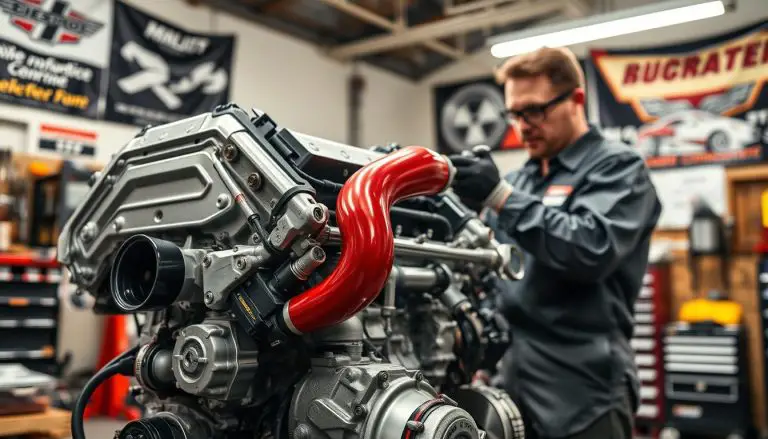
The advent of the Turbocharged Inline-Six engine has ushered in a paradigm shift within the automotive sector, marrying potency with parsimony. At its core lies the B58 Engine, a paragon of engineering that has been seamlessly integrated into a plethora of BMW Models.
This engine has garnered considerable acclaim for its remarkable performance metrics and technical prowess. Thus, it is imperative for aficionados and prospective purchasers to grasp the importance of the B58 Engine within BMW Models.
Key Takeaways
- The B58 Engine is a turbocharged inline-six engine known for its power and efficiency.
- It has been integrated into various BMW models, enhancing their performance.
- The engine’s technical specifications and performance characteristics are noteworthy.
- Understanding the B58 Engine is crucial for car enthusiasts and potential buyers.
- The Turbocharged Inline-Six engine has set a new standard in the automotive industry.
The B58 Engine: BMW’s Turbocharged Inline-Six Masterpiece
At the core of numerous contemporary BMW models resides the B58, a turbocharged inline-six exemplar. This engine has garnered considerable acclaim for its synergy of performance, efficiency, and dependability.

Technical Specifications and Architecture
The B58 engine showcases an array of technical specifications. It is equipped with a turbocharged inline-six configuration, striking a harmonious balance between power output and engine smoothness. Its architecture encompasses a closed-deck design, forged crankshaft, and sophisticated heat management systems. These elements are instrumental in its exceptional performance and durability.
The B58 engine’s displacement is 3.0 liters, with power outputs varying based on application. Its engine architecture is meticulously crafted to support high-performance capabilities while ensuring efficiency.
Development History and Design Philosophy
The genesis of the B58 engine was driven by BMW’s ambition to forge high-performance, efficient powertrains. The engine’s design philosophy aimed to harmonize power, torque, and fuel efficiency. BMW’s engineers leveraged advanced technologies, including turbocharging and direct injection, to achieve these objectives.
The B58 engine marks a pivotal advancement in BMW’s engine design, building upon the success of its predecessors with the incorporation of cutting-edge innovations. Its development history underscores BMW’s unwavering commitment to advancing the frontiers of automotive engineering.
What Makes the B58 Engine Special in the Automotive World
The B58 engine has transformed the automotive landscape with its unparalleled performance and cutting-edge design. As a turbocharged inline-six marvel, it showcases BMW’s engineering excellence, offering remarkable power and efficiency.
Power and Torque Characteristics
The B58 engine is celebrated for its power and torque characteristics. It boasts a maximum output of up to 382 horsepower and 369 lb-ft of torque in its most advanced forms, delivering thrilling performance. Its ability to provide smooth, linear power delivery is a testament to its design, making it a preferred choice among driving aficionados.
Below is a summary of the B58 engine’s power and torque specifications:
| Model | Power (hp) | Torque (lb-ft) |
|---|---|---|
| M340i | 382 | 369 |
| X3 M40i | 355 | 369 |
| Z4 M40i | 382 | 369 |
Closed-Deck Design and Forged Crankshaft
The B58 engine’s closed-deck design enhances its structural integrity, providing additional strength and rigidity. This design choice enables the engine to withstand higher stresses and pressures, making it suitable for high-performance applications. The engine also features a forged crankshaft, contributing to its durability and ability to handle high RPMs.

Heat Management and Efficiency Innovations
Effective heat management is essential for maintaining the B58 engine’s performance and efficiency. BMW has introduced several innovations to manage heat, including advanced cooling systems and optimized engine design. These features ensure the engine operates within optimal temperature ranges, even under demanding driving conditions.
“The B58 engine’s ability to balance performance and efficiency is a testament to BMW’s engineering expertise.”
The B58 engine stands out in the automotive world due to its innovative design, advanced materials, and sophisticated heat management systems.
Which BMW Models Have the B58 Engine?
The B58 engine, a turbocharged inline-six, has become a cornerstone in BMW’s model range, embodying a synergy of potency and efficiency. Its presence across a spectrum of BMW vehicles underscores its versatility and superior performance capabilities.
3 Series Applications (M340i, 340i)
The 3 Series, exemplified by the M340i and 340i, showcases the B58 engine’s prowess. These models benefit from the engine’s power and torque characteristics, offering a dynamic driving experience. The M340i, with its enhanced tuning, delivers exceptional performance, making it a favorite among driving enthusiasts.
5 Series and 7 Series Implementations
The 5 Series and 7 Series also utilize the B58 engine, offering a balance of luxury and performance. The 5 Series, notably the M550i and 540i, leverage the engine’s capabilities for smooth acceleration and responsive handling. In the 7 Series, the B58 engine contributes to a refined driving experience, combining power with luxury.
X Series SUVs with B58 Power
BMW’s X Series SUVs, including the X3 M40i, X5, X6, and X7, are equipped with the B58 engine, demonstrating its adaptability across different vehicle types. The X3 M40i, for instance, benefits from the engine’s agility and power, making it a compelling choice for those seeking a performance-oriented SUV.
Z4 Roadster and 8 Series Models
The Z4 Roadster and 8 Series models also feature the B58 engine, highlighting its application in BMW’s sports and luxury vehicles. The Z4 M40i, with its roadster design, pairs the engine’s performance with an open driving experience, while the 8 Series utilizes the B58 for its grand tourer capabilities.
In conclusion, the B58 engine is a versatile power unit that is integral to many BMW models, ranging from the 3 Series to the 8 Series, and including various X Series SUVs and the Z4 Roadster. Its widespread application underscores its significance in BMW’s current lineup.
B58 Engine Variants and Evolutionary Changes
The B58 engine, a testament to BMW’s engineering prowess, has undergone substantial transformations since its inception. This inline-six marvel has solidified its place in BMW’s repertoire, with successive updates aimed at boosting performance and efficiency.
First Generation B58B30M0 (2015-2018)
The inaugural B58 engine, designated as B58B30M0, emerged in 2015. It heralded a paradigm shift in BMW’s engine technology, introducing a turbocharged inline-six configuration. This iteration showcased enhancements in power transmission and fuel economy. The B58B30M0 garnered acclaim for its smooth power output and
Second Generation B58B30O1 and B58B30M1 (2019-Present)
BMW unveiled the second generation of the B58 engine in 2019, encompassing the B58B30O1 and B58B30M1 variants. These engines boasted several critical advancements, including improved turbocharging and enhanced engine management systems. The second generation witnessed significant strides in power output and fuel efficiency. These enhancements cemented the B58 engine’s status as a vanguard in its category.
Performance Analysis of B58-Powered BMW Models
The performance of BMW models equipped with the B58 engine exemplifies the pinnacle of engine engineering. Its turbocharged inline-six configuration offers a harmonious synergy of power, efficiency, and driving dynamics.
Acceleration, Top Speed, and Track Performance Data
BMW models, such as the M340i and X5 M50i, powered by the B58 engine, showcase remarkable acceleration and top speed capabilities. The M340i, for example, accelerates from 0 to 60 mph in a mere 4.1 seconds, attributed to its 382 horsepower and 369 lb-ft of torque. These models exhibit exceptional track performance, characterized by precise handling and responsive dynamics, catering to the driving preferences of enthusiasts.
Real-World Driving Dynamics and Fuel Economy
In real-world driving scenarios, the B58 engine excels, striking a balance between power and fuel efficiency. It boasts an estimated EPA rating of up to 24 mpg combined in certain models. The engine’s closed-deck design and forged crankshaft contribute to its durability and responsiveness, enhancing the overall driving experience.
In conclusion, the B58 engine significantly enhances the performance of BMW models, offering a compelling mix of acceleration, handling, and efficiency that appeals to a wide range of drivers.
Beyond BMW: The B58 Engine in Toyota Supra and Other Applications
The B58 engine, renowned for its performance in BMW models, has been integrated into the Toyota Supra through a groundbreaking partnership between the two automotive titans. This alliance underscores the engine’s versatility and its capacity to deliver exceptional performance across various platforms.
Toyota-BMW Partnership and Supra Implementation
The collaborative venture between Toyota and BMW has facilitated the exchange of engineering expertise, with the B58 engine serving as a pivotal component. Its selection for the Toyota Supra was predicated on its superior performance attributes, including its inline-six configuration and turbocharging technology. This engine imparts the Supra with formidable power and torque, thus elevating its overall driving experience.
Differences Between BMW and Toyota B58 Tuning
Despite the shared B58 engine, BMW and Toyota have distinct approaches to tuning. BMW’s tuning philosophy seeks a harmonious balance between performance and everyday drivability. In contrast, Toyota’s tuning for the Supra prioritizes track performance and handling, aligning with the brand’s performance ethos.
The tuning disparities extend to the engine’s software and hardware configurations. Toyota has tailored the Supra’s engine management system to optimize its performance for track driving. This understanding is paramount for enthusiasts contemplating modifications to their vehicles.
Tuning Potential and Aftermarket Support for B58 Engines
The B58 engine has emerged as a preferred choice among tuners, thanks to its robust design and significant potential for power upgrades. Its inline-six configuration, coupled with turbocharging, presents a versatile platform for performance enhancements. This configuration is pivotal in unlocking the engine’s full potential.
Popular Software Modifications and Power Gains
Software modifications are instrumental in unlocking the B58 engine’s tuning potential. By reflashing the engine control unit (ECU), a significant increase in power output can be achieved. Various tuning options are available, including:
- Stage 1 tunes: +50-70 horsepower
- Stage 2 tunes with downpipes: +100-120 horsepower
- Custom tunes: potentially higher gains with optimized calibration
These modifications not only enhance performance but also necessitate careful consideration of the engine’s reliability and durability.
Hardware Upgrades: Turbos, Intakes, and Exhausts
To further enhance the B58 engine’s performance, various hardware upgrades are available. These include:
| Upgrade | Description | Potential Gain |
|---|---|---|
| High-Performance Turbos | Improved turbochargers for increased boost pressure | +100-200 horsepower |
| Intake Systems | High-flow air intakes for better airflow | +10-20 horsepower |
| Exhaust Systems | High-performance exhausts for reduced backpressure | +20-50 horsepower |
Combining these hardware upgrades with software tuning can result in substantial power increases.
Reliability Considerations When Modifying
While modifying the B58 engine can yield impressive performance gains, it’s crucial to consider the impact on reliability. Increased power output can put additional stress on engine components, potentially leading to premature wear or failure if not properly managed.
To maintain reliability, it’s essential to:
- Monitor engine health closely
- Use high-quality tuning software and hardware
- Regularly service the vehicle
By balancing performance enhancements with careful maintenance, owners can enjoy the benefits of a tuned B58 engine while preserving its longevity.
Reliability and Maintenance: Owner Experiences with B58-Powered BMWs
Owner experiences with B58-powered BMWs provide invaluable insights into the engine’s reliability and maintenance requirements. As these vehicles gain popularity, grasping their long-term performance is essential for both current and prospective owners.
Common Issues and Preventative Measures
Several owners have encountered problems with the coolant system and high-pressure fuel pump. Regular inspections and maintenance of these components can avert significant issues. For example, maintaining the coolant at the recommended level and replacing it as specified can prevent overheating.
“We’ve witnessed instances where neglecting the coolant system has resulted in expensive repairs,” remarks a seasoned BMW technician. “Adherence to a regular maintenance regimen is paramount in averting such complications.”
Maintenance Schedule and Long-Term Ownership Costs
Compliance with BMW’s recommended maintenance schedule is crucial for the longevity of B58-powered models. This entails routine oil changes, filter replacements, and inspections of critical systems. While the initial investment in these vehicles is substantial, diligent maintenance can manage long-term ownership costs effectively.
The average annual maintenance expenditure for B58-powered BMWs is on par with other vehicles in its class. Yet, costs can fluctuate based on driving habits and environmental conditions.
Expert Technician Insights
Technicians with expertise in BMW repairs underscore the significance of proper care and timely maintenance in curtailing repair expenses and ensuring engine reliability. They also stress the criticality of utilizing genuine parts for replacements to preserve the vehicle’s performance and warranty.
By comprehending common issues, adhering to a recommended maintenance schedule, and heeding expert counsel, owners can maximize their enjoyment of B58-powered BMWs while mitigating potential drawbacks.
Conclusion: The B58’s Place in BMW’s Engineering Legacy
The B58 engine has entrenched itself as a pivotal element within BMW’s engineering legacy, showcasing a harmonious amalgamation of performance, efficiency, and cutting-edge design. This engine’s influence is palpable across a spectrum of BMW models, spanning from the 3 Series to the X Series SUVs, and extending beyond BMW’s purview into the Toyota Supra.
The B58 Engine Legacy stands as a testament to BMW Engineering’s unwavering dedication to advancing automotive technology. Its turbocharged inline-six configuration has redefined the benchmarks for driving dynamics and performance. The engine’s closed-deck design, forged crankshaft, and sophisticated heat management system collectively contribute to its unparalleled power output and durability.
As the automotive sector continues to progress, the B58 engine retains its pivotal role, with its tuning potential and aftermarket support offering a plethora of customization avenues for owners. The reliability and maintenance aspects of B58-powered BMWs have garnered widespread acclaim from owners, further solidifying the engine’s esteemed reputation.
In conclusion, the B58 engine is an indispensable component of BMW’s engineering heritage, embodying a synergy of performance, innovation, and driving exhilaration that continues to enthrall automotive aficionados globally.
FAQ
What BMW models come with the B58 engine?
The B58 engine is featured in various BMW models, including the M340i and 340i from the 3 Series, certain variants of the 5 Series and 7 Series, X Series SUVs like the X3 M40i, X5, X6, and X7, as well as the Z4 Roadster and some 8 Series models.
What are the key technical specifications of the B58 engine?
The B58 engine is an inline-six turbocharged engine known for its closed-deck design, forged crankshaft, and advanced heat management system, contributing to its high performance and efficiency.
How does the B58 engine perform in terms of power and torque?
The B58 engine delivers robust power and torque across its rev range, making it suitable for a variety of driving conditions, from everyday driving to track performance.
Are there different variants of the B58 engine?
Yes, the B58 engine has evolved over time, with the first generation introduced between 2015 and 2018, and the second generation from 2019 onwards, each with its own set of enhancements and improvements.
Can the B58 engine be tuned for more performance?
The B58 engine has a strong aftermarket support, allowing for various tuning options, including software modifications and hardware upgrades like turbos, intakes, and exhausts, to increase its performance.
What are the reliability and maintenance considerations for B58-powered BMWs?
Owners of B58-powered BMWs generally report good reliability, but like any high-performance engine, regular maintenance is crucial. Common issues can be mitigated with preventative measures, and adhering to a recommended maintenance schedule is key to long-term ownership.
Is the B58 engine used in any non-BMW vehicles?
Yes, the B58 engine is also used in the Toyota Supra, thanks to a partnership between Toyota and BMW. There are differences in how the engine is tuned for Toyota versus BMW models.
What are the benefits of the B58 engine’s closed-deck design and forged crankshaft?
The closed-deck design and forged crankshaft of the B58 engine provide structural advantages that enhance its performance and durability, notably under high-stress driving conditions.